Why Walking Conversations Go Deeper Than Sitting Ones
Quick Answer: Walking removes sustained eye contact, which lowers the social pressure that makes difficult topics hard to raise. It also provides a shared external focus, a natural rhythm that tolerates silence, and a defined endpoint that makes the conversation feel bounded rather than open-ended. The combination is why people reliably say more on a walk than across a table - and why it is the most useful format for a conversation you have been putting off.
You have been meaning to have a particular conversation with a particular person for about two months. Every time you plan it as a coffee, it does not happen or it stays on the surface. Suggest a walk instead and it usually happens within the first fifteen minutes, without anyone deciding it should.

Why does removing eye contact help so much?
Because sustained eye contact is cognitively and socially demanding, and that demand competes with difficult disclosure.
Direct gaze increases arousal. Mutual eye contact reliably raises physiological arousal, and while that can be positive and connecting, it also raises the cost of saying something uncomfortable. Sitting opposite someone means every pause is observed.
Gaze aversion is what people do naturally when thinking hard. Watch anyone answering a difficult question and they look away. This is not evasion - it reduces the cognitive load of processing a face while simultaneously constructing something complex to say. Walking side by side makes gaze aversion the default rather than something you have to do deliberately, which removes a small but real friction from every difficult sentence.
Silence stops being awkward. Across a table, a ten-second silence is an event that someone has to resolve. On a walk, ten seconds of silence is just walking. That difference matters enormously, because the pauses before someone says a hard thing are usually longer than a seated conversation comfortably allows.
And the listener is less exposed too. Reacting to something difficult is easier when your face is not being watched. People disclose more readily to someone who is not visibly evaluating their disclosure in real time.
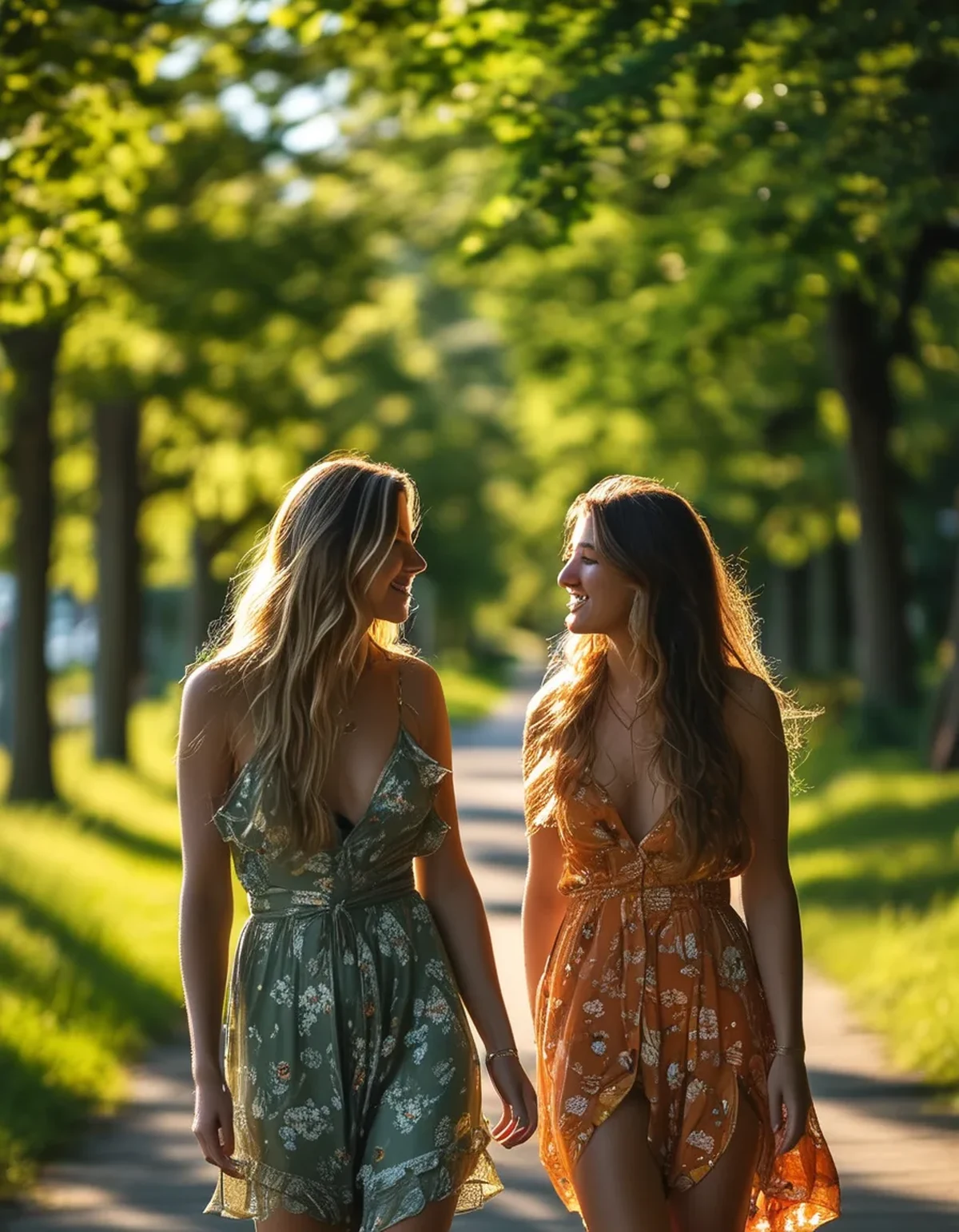
This is the same principle behind conversations in cars, which people frequently identify as where their most significant conversations happen. Same geometry - side by side, shared forward focus, no obligation to look at each other.
What does the shared external focus do?
It provides a continuous supply of low-stakes material, which turns out to be structurally important.
A conversation needs somewhere to go when it needs a break. Difficult topics are not sustained continuously - people approach, retreat, and approach again. Sitting across a table, retreating means changing the subject, which is a visible act. Walking, retreating means commenting on a dog, or a house, or the fact that it is getting dark earlier.
Those interruptions are not failures of the conversation. They are the recovery periods that make the harder parts possible. A walk supplies them for free, roughly every ninety seconds, without anyone having to generate them.
Novelty keeps attention engaged. A changing environment provides continuous mild stimulation, which appears to support sustained conversation better than a static one. It is harder to feel bored or trapped when the scenery is moving.
And the shared direction is a small but real signal. Both people facing the same way, moving toward the same place, is a physical arrangement that suggests alliance rather than negotiation. Facing someone across a table is the geometry of an interview or a transaction.
There is also the movement itself. Physical activity has documented effects on mood and anxiety, and even a gentle walk produces some of them within about ten minutes - which is roughly when walking conversations tend to shift from small talk into something else.
What Nobody Tells You About Walk-and-Talks
The first ten minutes are always small talk, and that is functional. People expect the conversation to start immediately and worry when it does not. The opening stretch is calibration - matching pace, settling breathing, establishing that this is comfortable. The real conversation reliably starts somewhere between minute ten and minute twenty, and trying to accelerate it does not work.
Pace matters more than people realise. A pace that makes either person slightly breathless kills the conversation, because talking requires spare breathing capacity. Conversational pace is not a metaphor here - it is a physiological limit. If one person is faster, they should slow down.
A loop is better than an out-and-back. An out-and-back has an obvious halfway point where the conversation gets consciously reviewed, and a return leg that feels like winding down. A loop has no such structure and tends to hold the conversation better.
The endpoint being defined is a feature. “An hour’s walk” is a bounded commitment, which makes people more willing to raise something significant - there is a guaranteed exit. An open-ended coffee has no such guarantee, and that lack of a boundary quietly discourages difficult topics.
Phones ruin it entirely, and the mechanism is specific. A phone in view reduces conversation quality and perceived closeness even when it is not used. On a walk, put it away entirely rather than holding it.
And the same-side rule matters. Walking exactly side by side works. Walking one slightly ahead recreates a hierarchy and makes the person behind talk to a shoulder. Adjust to stay level - it is a small thing that changes the feel considerably.
How to actually set one up
Suggest the walk, not the conversation. “Fancy a walk on Saturday?” is a much easier invitation to accept than “I want to talk to you about something.” The second one creates anticipatory anxiety for both people and frequently produces a rehearsed conversation rather than a real one.
Pick 45 to 90 minutes. Under 30 minutes rarely gets past the calibration phase. Over about 90 minutes and physical fatigue starts competing with attention. An hour is close to ideal.
Choose a route neither of you has to navigate. Route-finding takes attention and creates interruptions of the wrong kind. A familiar loop, or somewhere with an obvious path, keeps the cognitive load where it should be.
Avoid busy roads. Traffic noise forces louder speech, and louder speech is a genuine barrier to saying quiet things. This is one of the most practical constraints and the most commonly ignored.
Late afternoon is the best slot in autumn. The light is good, the temperature is comfortable, and there is a natural endpoint as it gets dark. In late August that is around 6 to 7pm, and it shifts earlier through September - which is worth noticing, because this window quietly shrinks by about an hour a month from here.
Make it recurring if it works. A standing weekly or fortnightly walk with the same person is one of the highest-value social structures available, because it removes the arranging - which is the step where most adult friendships quietly fail. The friendship that has a standing slot survives; the one that requires organising each time usually does not.
And a note on who this works for: it is particularly effective with people who find direct emotional conversation difficult, which includes a lot of people. Offering a format that removes the face-to-face demand is a genuine kindness rather than a workaround.
FAQ: Walking Conversation Questions, Answered
Why are conversations easier while walking?
Because walking side by side removes sustained eye contact, which lowers the social pressure on difficult disclosure. It also makes silence unremarkable, supplies low-stakes material to retreat to, and provides a defined endpoint that makes people more willing to raise significant things.
How long should a walk-and-talk be?
45 to 90 minutes, with an hour being close to ideal. The first ten to twenty minutes are calibration and small talk, which is functional rather than wasted, so anything much under 30 minutes rarely gets past that stage.
Should I tell someone I want to talk about something serious?
Usually not in advance. Suggesting the walk rather than the conversation is easier to accept and avoids the anticipatory anxiety that produces a rehearsed, careful conversation instead of a real one. The subject tends to arrive on its own somewhere in the second twenty minutes.
What makes a good route for a walking conversation?
A familiar loop that neither person has to navigate, away from busy roads, at a pace slow enough that both of you can talk comfortably. Traffic noise forces louder speech, and louder speech is a real barrier to saying quiet things.
TL;DR:
- No sustained eye contact means less pressure, and gaze aversion becomes the default.
- Silence is just walking, so the long pauses before hard sentences are permitted.
- The changing scenery supplies retreat material every ninety seconds, for free.
- The real conversation starts between minute ten and twenty. Do not rush it.
- Suggest the walk, not the conversation. And make it recurring if it works.
You have tried to have this conversation across three tables. Try it facing the same direction and it will probably happen before you reach the end of the road.
Keep Reading
This article is for general informational and styling purposes only. Fit, sizing, and product availability may vary.