Why Friendships Get Quieter in September — and What to Do About It
Quick Answer: September social contact drops for structural reasons — summer’s long evenings, holidays, and loose schedules all end at once, and autumn routines fill the calendar before anyone deliberately chooses what to keep. It is a scheduling problem that feels like a relationship problem. The fix is putting a small number of recurring, low-effort contacts into the calendar before October fills it.
Almost everyone experiences this and almost nobody names it, which is why it feels personal.

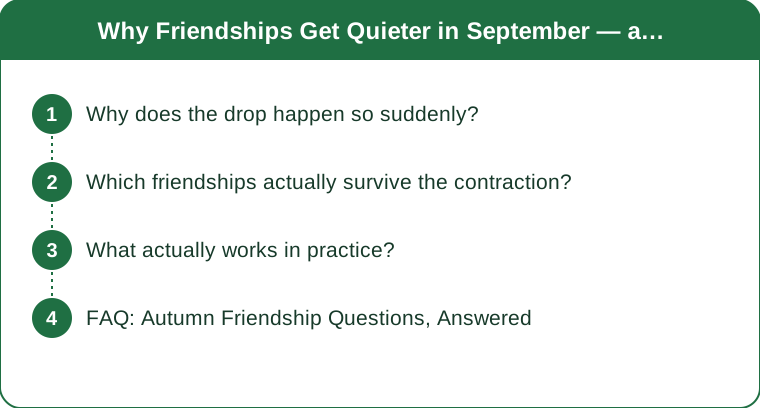
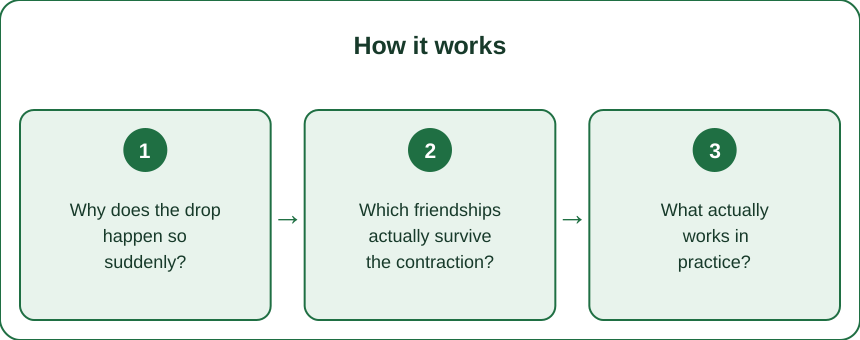
Why does the drop happen so suddenly?
Summer inflates contact artificially. Long light evenings make spontaneous plans possible, holidays produce shared time, and looser work schedules leave room. None of that is a measure of how close the friendship is — it is a measure of how much slack the season provided.
Autumn removes the slack all at once. School terms, work cycles, and darker evenings arrive within about two weeks of each other. The available hours contract sharply while the number of people in your life stays the same.
Darkness changes willingness, not just availability. People are measurably less likely to leave the house for optional plans after dark, and by late September the 7pm meet-up happens in the dark for the first time since March.
Everyone assumes they are the one who stopped reaching out. Because the contraction is mutual and unspoken, both people quietly conclude the other has become less interested. This is the single most common misreading of the season.
Which friendships actually survive the contraction?
The ones with a structure, not the ones with the most affection. A monthly walk that exists in both calendars survives October. A deeply valued friendship that depends on someone deciding to text does not, regardless of how much both people care.
Proximity matters less than people think. The friend across town whom you see by arrangement often survives better than the friend nearby whom you see by chance, because chance encounters are exactly what autumn removes.
Group contact is fragile; one-to-one is robust. Coordinating five diaries in October is functionally impossible, and groups that met easily in July can go quiet for months. Two people can always find an hour.
Low-effort recurring contact outperforms high-effort occasional contact. A twenty-minute phone call every fortnight sustains a friendship better than a three-hour dinner every four months, and it is far easier to protect when the calendar is full.

What actually works in practice?
Put it in the calendar now, before October arrives. The window where you still have discretion over your autumn schedule is roughly the last week of August and the first week of September. After that you are negotiating against commitments that already exist.
Choose recurring over one-off. The same day each month removes the entire coordination cost, which is what actually kills plans.
Attach it to something you already do. A walk you were going to take anyway, a commute, a gym session. Friendships that share an existing activity survive busy seasons far better than ones requiring a separate slot.
Lower the bar deliberately. A fifteen-minute call while you cook counts. The belief that contact must be substantial to be worthwhile is what turns a quiet month into a quiet year.
Say the thing out loud. Naming the pattern — telling a friend that autumn always eats the calendar and suggesting a fixed monthly slot — is a small conversation that prevents a long silence, and almost everyone responds with relief rather than surprise.
FAQ: Autumn Friendship Questions, Answered
How do I restart contact after months of silence?
Directly and without apology-heavy framing. A specific offer — a date and an activity — is far easier to respond to than an open-ended message, and the long gap matters much less to the other person than you expect.
Is it normal to have fewer close friends in your thirties and forties?
Yes. Network size tends to peak in the mid-twenties and narrow afterwards, with the remaining relationships typically deepening. Fewer is not the same as worse.
What if the effort feels one-sided?
Count over months rather than weeks — most people’s reaching-out is bursty rather than even. If it is genuinely one-directional over a long period, a direct conversation is more useful than gradually withdrawing, which is the default and the least effective option.
TL;DR:
- September contact drops because summer’s slack disappears, not because friendships weakened.
- Both people usually assume they are the one who stopped, which is why it feels personal.
- Structure beats affection — recurring calendar slots survive autumn; spontaneity does not.
- One-to-one contact is far more robust than group plans once diaries get full.
- Book the recurring slots in the first week of September, before the calendar fills.
The friendships that make it through winter are the ones that got scheduled in early autumn. It is unromantic and it is true.
Keep Reading
This article is for general informational and styling purposes only. Fit, sizing, and product availability may vary.