Why the Friend You See Least Is Often the Easiest to See
Quick Answer: Proximity removes urgency. When someone is nearby, every specific plan competes against the assumption that any time would work, so no time gets chosen - the psychological term for this is a lack of implementation intention. Distance forces the opposite: a visit has to be a date, a duration and a commitment, which is exactly what makes plans actually happen. The fix for local friendships is to import the structure that distance imposes automatically - a recurring slot, a shared activity, or a standing default rather than an open-ended intention to meet up soon.
You have a friend who lives fifteen minutes away. You genuinely like them. You have been meaning to see them since June.
You also have a friend three hours away who you saw last month, because they said what weekend and you said yes.
This is one of the most common and least examined patterns in adult friendship, and it says nothing at all about who you care about more.

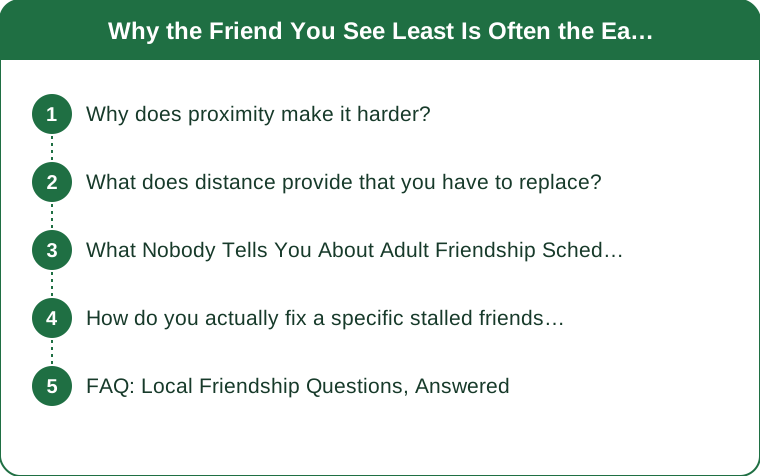
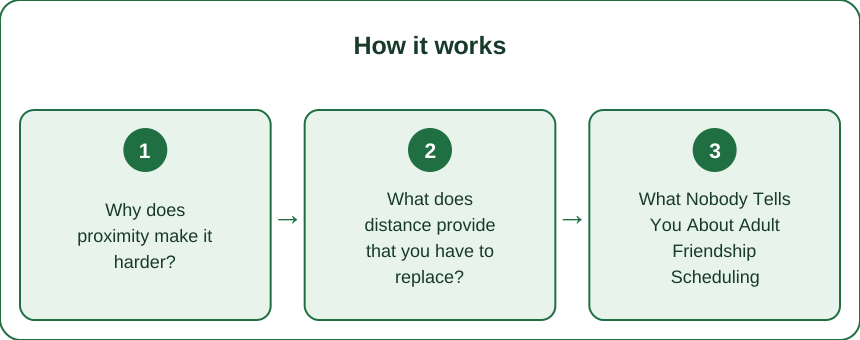
Why does proximity make it harder?
Because a plan needs a specific time to exist, and proximity actively prevents one from being chosen.
When a friend lives far away, a visit requires a date, travel, and usually a duration. The logistics force specificity, and specificity is what converts an intention into an event. You cannot vaguely visit someone three hours away.
When a friend lives nearby, none of that applies. Any evening could work. Any weekend could work. And because any time would work, no particular time gets chosen - which is a well-documented pattern in how people convert intentions into actions. Vague intentions produce far less follow-through than specific ones with a time and place attached.
There are two other mechanisms working alongside it:
No scarcity, so no urgency. A distant friend’s visit is a limited window - you organise around it because you have to. A local friend is available indefinitely, so there is never a reason for this week specifically.
The bar gets higher, not lower. A distant visit is inherently an event, so a whole day together is normal. A local meeting has to justify itself against a normal evening, and paradoxically that means people wait for a good enough reason - which arrives less often than an ordinary one would.
And a fourth: nobody escalates. Because both people assume it is easy, both wait for the other to suggest something, and neither treats it as time-sensitive. The distant friend books a train and forces the issue.
None of this is about caring less. It is about a structural difference in how the two kinds of plan get made.
What does distance provide that you have to replace?
Three things, and you can install all of them deliberately.
A fixed date. A visit gets a date because it must. Local plans need one imposed on them - and the most effective form is recurring rather than negotiated each time.
A duration. A visit is a day or a weekend, agreed in advance. Local meetings have an undefined length, which sounds relaxed and actually makes them harder to fit into a calendar. An hour, agreed, is easier to say yes to than an open-ended evening.
A shared activity or purpose. Travel gives the meeting a shape - you are visiting, so there is an implicit programme. A local coffee has to be entirely constructed from conversation, which is fine and is also more effort to initiate.
The replacement for all three is the same thing: a standing arrangement.
A recurring slot - the first Tuesday, every other Thursday, Sunday mornings. The single most effective intervention available for local friendship, because it removes the negotiation entirely. Nobody has to suggest anything, which is the step that fails.
A shared activity - a class, a walk, a run, a book group. Friendships built around a recurring activity survive schedule pressure far better than ones that depend on someone initiating, because the activity is the reason and the friendship comes along with it.
A default that requires cancelling rather than arranging. This is the crucial inversion. “We walk on Sunday unless one of us says otherwise” produces vastly more meetings than “let’s arrange a walk sometime” - because the effort has moved to the cancellation rather than to the arrangement.

What Nobody Tells You About Adult Friendship Scheduling
Scheduling far out reduces the chance it happens. A plan made for four weeks’ time competes against four weeks of things that have not come up yet - and it loses more often than a plan made for this Thursday. The further out the plan, the more likely it is to be moved, and each move makes the next one easier.
Frequency matters more than duration. Four one-hour meetings across a month build considerably more connection than one four-hour meeting. Frequent short contact keeps the relationship current; infrequent long contact means each meeting starts with a catch-up that eats the whole time.
The catch-up tax is real and it compounds. After six months apart, the first hour is spent updating each other on facts. After two weeks, you skip straight to whatever is actually happening. Longer gaps produce shallower conversations, which is the opposite of what people expect.
Walking beats sitting for reconnection. Side-by-side conversation without sustained eye contact reliably produces more open talking, and a walk has a natural start and end, which solves the duration problem at the same time.
Low-effort contact between meetings maintains more than you think. A voice note, a photo, a two-line message. It is not a substitute for meeting, but it keeps the thread live so the next meeting is not starting from cold.
And September is genuinely the hardest month for this. Schedules restart, calendars fill in a fortnight, and the flexible summer arrangements disappear. The friendships that survive autumn are the ones that got a fixed slot before the calendar closed - which makes the next two weeks the moment to install one, not December.
How do you actually fix a specific stalled friendship?
Propose something concrete and small, and make it recurring if it works.
Do not say we should catch up soon. It is the phrase that reliably produces nothing, because it contains no time, no place and no duration. It also puts the work of proposing something on the other person, who is in exactly the same position you are.
Propose a specific time, close to now. “Are you free Thursday at 7 for an hour?” Two days out beats three weeks out. Specific beats open. An hour beats an evening.
Suggest something with a shape. A walk, a coffee, going to the same thing you both wanted to do anyway. The activity removes the need to construct the meeting from nothing.
If it works, make it recurring immediately. At the end of the first one: “Same time in two weeks?” This is the highest-leverage sentence in the whole thing and it takes three seconds. It converts a one-off into a system.
Set the default toward meeting. A standing arrangement that requires cancelling produces far more meetings than one that requires arranging. Both people get to cancel freely, which is what makes it sustainable.
Lower the bar deliberately. A meeting does not have to be a good use of an evening. Twenty minutes for a coffee, a walk to the shops together, sitting in a park. The friendships that last are the ones with a low floor, not the ones with a high ceiling.
And do not read the gap as a signal. The most common misinterpretation is that a long gap means the other person is not interested - when they are almost certainly experiencing exactly the same thing from their side, and waiting for the same message you are waiting for.
FAQ: Local Friendship Questions, Answered
Why do I find it easier to see people who live further away?
Because distance forces a specific date, a duration and a commitment, and those three things are what turn an intention into an event. Proximity removes all of them - any time would work, so no time gets chosen. It is a scheduling structure difference, not a difference in how much you value the friendship.
Is a recurring slot too rigid for a friendship?
It sounds rigid and in practice it does the opposite - it removes the negotiation that is where most plans fail. Both people can cancel any individual instance without the arrangement collapsing, which is exactly what makes it sustainable. What kills local friendships is not rigidity, it is that nobody ever proposes a specific time.
What if I suggest something and they do not respond?
One unanswered message is much more likely to be a busy fortnight than a statement about the friendship - people are genuinely overloaded, particularly at this time of year. Try once more with something specific and small a couple of weeks later. If a pattern of non-response emerges over several attempts, that is information, and it is worth accepting without making it a confrontation.
TL;DR:
- Proximity removes urgency. Any time would work, so no time gets chosen - and a plan without a specific time does not happen.
- Distance supplies three things automatically: a date, a duration and a commitment. Local friendships need those installed deliberately.
- A recurring slot is the single most effective fix - it removes the negotiation, which is the step that fails.
- Set the default toward meeting: an arrangement you have to cancel produces far more meetings than one you have to arrange.
- Frequency beats duration, and longer gaps produce shallower conversations because the catch-up eats the time.
September closes calendars fast. The friendships that survive autumn are the ones that get a fixed slot in the next fortnight.
Keep Reading
This article is for general informational and styling purposes only. Fit, sizing, and product availability may vary.