Why the Group Chat Quietly Replaces the Actual Plan
Quick Answer: Group chats satisfy enough of the social need that the urgency to meet disappears, while providing very little of what actually maintains a friendship. The chat delivers information and low-grade contact; it does not deliver shared experience, sustained attention, or the accumulated small moments that friendships are built from. The result is a relationship that feels current and is quietly thinning.
The fix is not less chat. It is making one recurring, low-effort, calendared thing that does not require a decision each time.

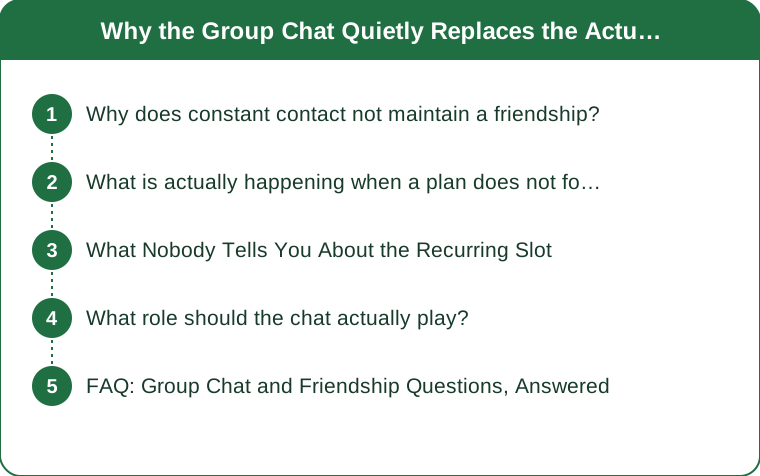
Why does constant contact not maintain a friendship?
Because it satisfies the signal without delivering the substance.
A group chat provides awareness - you know what is happening in each other’s lives, you exchange reactions, you feel connected. That awareness is genuinely pleasant and it registers as social contact.
What it does not provide is what friendship research consistently identifies as the maintaining ingredient: shared time and shared experience with sustained attention. The distinction matters because those two things are not on a spectrum. Knowing about someone’s week is a different category of thing from being present in it.
The mechanism that makes this a problem is subtle. If you had no contact with a friend for three months, you would feel the absence and act on it. The chat removes that signal. You do not feel out of touch, so you do not initiate. Meanwhile the actual relationship - built on shared experience - has had no input since May.
This is why the realisation often arrives suddenly and specifically: someone says how long has it been, everyone works it out, and the number is much larger than anyone expected. The felt sense of closeness was accurate about the contact and completely wrong about the connection.
There is also a diffusion effect specific to groups. In a one-to-one relationship, if you do not reply, the conversation ends and you notice. In a group of six, the conversation continues without you, so no individual relationship within it ever registers neglect. The group stays alive while every pair inside it quietly goes dormant.
What is actually happening when a plan does not form?
A predictable failure sequence that has almost nothing to do with how much people want to meet.
It usually goes:
- Someone says we should do something soon. General agreement, warm feelings all round.
- Someone proposes a date. Two people can, one cannot.
- Someone proposes an alternative. Different two cannot.
- The thread moves on to something else.
- Two weeks later, step one repeats.
Each round of this costs real effort and produces nothing, and after a few cycles people stop initiating - not because they care less, but because initiating has a poor track record. The learned expectation becomes that plans do not happen, which is self-fulfilling.
The structural problem is that group scheduling difficulty rises steeply with group size. With four busy adults, finding an evening everyone can do often requires looking three or four weeks out, and at three or four weeks out nobody’s calendar feels real, so commitment is soft and cancellations are likely.
There is also a quality inflation problem. The longer since you last met, the more the meeting feels like it should be significant - a proper dinner, a whole day, something worth the wait. Higher stakes mean higher coordination cost, which means it happens even less. Six months of not meeting turns a coffee into an event, and events are hard to schedule.
The most useful reframe: the barrier is not desire and it is not time. It is that every meeting requires a fresh negotiation, and fresh negotiations are expensive.

What Nobody Tells You About the Recurring Slot
The single most effective intervention in adult friendship is boring and structural: make it recurring, so it never has to be decided again.
A recurring commitment changes the economics completely. Instead of negotiating each time, you negotiate once. Instead of everyone needing to be free, you accept that whoever is free comes. Instead of the plan requiring energy, the default requires energy to break.
What makes a recurring slot work:
- A fixed time, not a fixed frequency. First Tuesday of the month works. Once a month does not - it decays into never.
- A default location. Deciding where is a surprisingly large fraction of the total coordination cost. The same pub, the same park, the same person’s kitchen.
- Whoever comes, comes. This is the critical rule. If the meeting requires everyone, it will keep failing. If it happens with two people, it survives.
- Low stakes and low cost. A coffee or a walk beats a dinner, because it is easy to attend on a mediocre week. The thing that must survive is the slot, not the quality of any individual instance.
- An anchor to something existing. A walk after the school drop-off, a coffee before an existing commitment, a class you all attend. Attaching to something already in the calendar removes most of the failure modes.
One uncomfortable but useful point: someone has to own it. Recurring things that belong to everyone belong to nobody. In practice, almost every long-running friendship group has one person who quietly does the reminding, and if you are reading this and wondering who that is in your group, it may need to be you.
The payoff is disproportionate. A monthly walk that actually happens produces more friendship maintenance in a year than eighteen months of enthusiastic messaging.
What role should the chat actually play?
A useful one, once you stop expecting it to do a job it cannot do.
The chat is genuinely good at some things:
- Continuity between meetings. Knowing the small updates means you do not spend the first hour of every meeting catching up on logistics.
- Low-cost contact for people who would otherwise drop out entirely. For friends in different time zones or life stages, the chat may be most of what is available, and it is much better than nothing.
- Coordination, if it is used for that rather than instead of it.
- Shared attention on something. A chat that regularly shares a specific thing - a running joke, a shared interest, photos - creates something closer to shared experience than general conversation does.
What it is bad at is being the whole relationship.
A reasonable division:
- Use the chat for continuity, and one-to-one contact for depth. The group is where information lives; individual conversations are where friendship actually happens. If every interaction with a close friend is happening in a group of eight, that friendship is thinner than it appears.
- Move one relationship to a phone call occasionally. Voice carries considerably more than text, and a 15-minute call does more than a week of messages.
- Use the chat to protect the slot, not to plan new things. A reminder two days before an existing recurring thing is a much better use of the group than another round of we should do something.
And one thing worth saying plainly: friendships thinning in your thirties and forties is close to universal, and it is a structural consequence of work, children, and geography rather than a personal failing. Treating it as a logistics problem rather than a character problem is both more accurate and considerably more solvable.
FAQ: Group Chat and Friendship Questions, Answered
How often do adult friends actually need to meet?
There is no established number, and it varies enormously with history. Long-standing friendships tolerate long gaps well - decades of shared history do not evaporate. Newer friendships need much more frequent contact to consolidate. If a friendship is under about two years old, monthly is roughly a floor; older ones survive on far less.
What if I am always the one organising?
Common, and worth addressing directly rather than resentfully. The most effective move is to make the thing recurring so it stops needing an organiser, and then to hand over one specific piece - someone else picks the location, someone else sends the reminder. Most people are happy to contribute and have simply never been asked.
Is it worth keeping a group chat that never leads to meeting?
Often yes, on its own terms. A chat that provides pleasant low-grade contact with people you like is a good thing. The problem is only when it is mistaken for maintenance of a close friendship. Keep the chat, and separately build one recurring thing with the two or three people you actually want to stay close to.
Why is September specifically hard for this?
Calendars refill fast as school and work schedules restart, and the summer looseness that made spontaneous plans possible disappears within about two weeks. Anything not booked before the calendar refills tends not to happen until the new year. This is a good fortnight to put a recurring slot in place, before the space closes.
TL;DR:
- Group chats remove the felt signal of being out of touch while providing none of the shared experience that maintains friendship.
- In a group, no individual relationship ever registers neglect, because the conversation continues without any one person.
- The plan fails because every meeting requires a fresh negotiation, and the longer the gap the more the meeting has to justify itself.
- Make one recurring, fixed-time, fixed-location, low-cost thing, with the rule that whoever comes, comes.
- Someone has to own it - recurring things that belong to everyone belong to nobody.
Put the slot in before the calendar refills this month. After mid-September the space closes until January.
Keep Reading
This article is for general informational and styling purposes only. Fit, sizing, and product availability may vary.