Why Some Friendships Only Work in One Setting
Quick Answer: Some friendships depend on a shared context that supplies the structure — a time, a place, a shared activity and a natural ending. Move them out of it and the thing that made them easy is gone. This is not a shallow friendship failing a test; it is a different kind of friendship with real value. The mistake is either dismissing it or forcing it into a form it was never built for.
You see someone twice a week for two years. You know about their knee, their job, their opinion on the new instructor. Then you meet for dinner and it is oddly effortful.
Most people read that dinner as evidence the friendship was not real. It usually means something more specific and more useful.

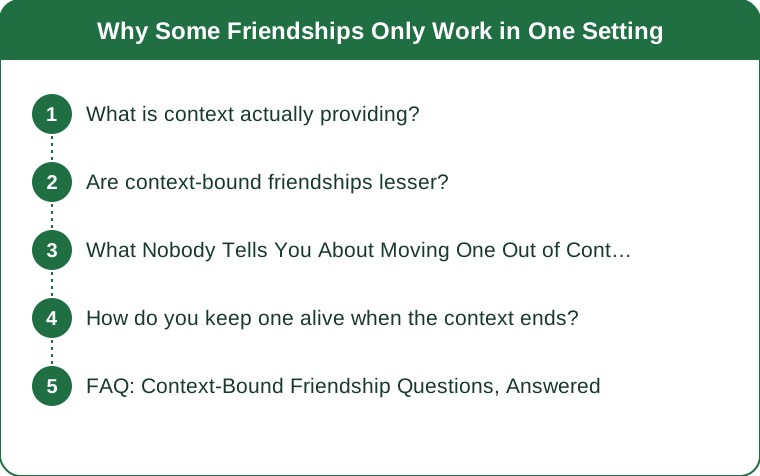
What is context actually providing?
Four things that a friendship otherwise has to generate on its own.
A guaranteed shared subject. In a shared context there is always something to talk about that you are both currently experiencing. The class, the project, the route, the instructor. Conversation has a floor beneath it and never has to be invented.
A schedule you do not have to negotiate. The hardest logistical part of adult friendship is agreeing when. Context solves it — you are both there on Tuesday because you were always going to be there on Tuesday. Nobody has to propose anything, which means nobody has to risk a no.
A natural ending. The class finishes, the shift ends, the run is over. Nobody has to decide when to leave, which removes a surprising amount of low-level social effort.
A defined role. You know who you are in that space. Out of it, the role dissolves and you are two people with no script.
Remove all four at once and the friendship has to supply them itself, which is a genuinely different task. The awkward dinner is not revealing that you never liked each other. It is revealing that you have never had to generate a conversation from nothing, agree a time, or decide when to leave — and you are doing all three at once, for the first time, over a meal.
Seen that way, a slightly stiff first dinner is entirely expected rather than diagnostic.
Are context-bound friendships lesser?
No, and treating them as lesser is a specific error worth naming.
The cultural default ranks friendships by intimacy and duration, which makes anything context-bound look like a lower rung. But research on wellbeing consistently finds value in weak ties — regular, low-intensity, friendly contact with people you do not know deeply. The barista, the neighbour, the person at the same class. These relationships contribute meaningfully to a sense of belonging, and they do so without requiring the maintenance close friendships need.
They also do something close friendships cannot. A context friendship gives you a version of yourself that exists outside your main life. The person at your class does not know about your work stress or your family situation unless you bring it, and there is real relief in a relationship with no accumulated history.
They are also the most reliable route to new close friendships. Repeated, unplanned proximity is what builds friendship, which is why friendships form so easily at school and at work and so rarely afterwards. A context friendship already has the proximity. Some of them deepen. Most do not, and that is not a failure rate.
The honest accounting: most people’s friendships are mostly context-bound, and always have been. What changes with age is that the contexts change more often, so the friendships turn over more visibly. That feels like a personal decline and is mostly a structural one.
The one real cost: context friendships end abruptly when the context does. Leaving a job or a class ends several relationships at once, with no falling out and no conversation, which is disorienting in a way people rarely have language for.

What Nobody Tells You About Moving One Out of Context
It can work, and the way people usually attempt it is the way least likely to succeed.
Dinner is the hardest possible first move. It is long, it is face-to-face with nothing else to do, it has no natural exit, and it removes the shared activity entirely. Every one of the four supports is gone at once. If dinner is the test, plenty of perfectly good friendships fail it.
Adjacent beats separate. Coffee immediately after the class you both already attend. A walk instead of a run. Something that keeps the shared activity nearby while extending the time slightly. Success rates are much higher because you are removing one support rather than all four.
Keep the first attempt short and bounded. Forty minutes with a reason to leave is far easier than an open evening. Both people can relax because neither is committed to filling three hours.
Expect the second meeting to be better than the first. Almost universally. The first one carries the awkwardness of a changed frame; the second has a precedent. People frequently write off a friendship after one flat coffee, which is judging on the least representative data point available.
Bring a third context rather than none. An activity — a market, an exhibition, a walk somewhere new — supplies the shared subject that the original context used to. Two people who only ever talked about running will find a walk easier than a table.
And accept that some do not transfer, and that this is not a verdict on either person. The friendship was real. It was built on something specific, and outside it there is less to hold. That is a legitimate ending, and it does not retroactively make the two years less good.
How do you keep one alive when the context ends?
Deliberately, quickly, and with an explicit replacement — because these are the friendships most likely to evaporate silently.
Act within the first month. Context friendships fade fast when the context goes, and the window where reaching out feels natural is short. After three months it starts to feel like a bigger gesture, which makes it less likely to happen at all.
Name it directly. I would miss seeing you now that I am not at the Tuesday class — do you fancy a walk once a month? This is more effective than a vague let us keep in touch, because it proposes a concrete replacement structure. Vagueness is what kills these.
Replace the structure, not just the contact. The friendship ran on a repeating slot. A recurring, low-effort arrangement — a monthly walk, a standing coffee — recreates what made it work. Occasional spontaneous meetings do not, because they reintroduce the negotiation problem that context was solving.
Accept a lower frequency. Twice a week becomes once a month. That is not a downgrade in the friendship, it is the realistic version without the shared logistics. Expecting the old frequency guarantees disappointment.
Be honest about capacity. You cannot convert every context friendship into a maintained one, and trying is how people end up with a calendar full of obligations and no energy. Pick the two or three that mattered most.
Seasonally, this is the month when a lot of contexts change at once. Schedules reset, classes restart on different nights, work patterns shift, people move. A number of friendships are quietly about to end because of a timetable change rather than anything else — and a single message in the next couple of weeks is usually enough to keep the ones worth keeping.
FAQ: Context-Bound Friendship Questions, Answered
How do I know if it is worth moving out of context?
A useful test: do you think about them when they are not there? Do you have things you want to tell them that are not about the shared activity? Both point to something that will transfer.
What if I ask and they say no?
Most declines are logistical rather than personal, and the friendship inside the context generally continues completely unaffected. The risk is smaller than it feels.
Is it strange to only see someone in one place for years?
Not at all, and it is extremely common. Most people have several. The strangeness is entirely in the framing, not in the relationship.
What if the friendship was mostly complaining about the shared thing?
Then it probably will not transfer, and that is fine. Shared grievance is a real bond and a narrow one. It served its purpose.
How do I make context friendships in the first place as an adult?
By showing up to the same thing repeatedly at the same time. Consistency of attendance does more than any social effort — a class you attend every Tuesday for six months will produce acquaintances, and a class you attend randomly will not.
What if I miss someone I only knew from a context that ended?
That grief is real and rarely acknowledged, because there is no name for the relationship and no event to mark its end. Reaching out late is almost always better received than people expect.
TL;DR:
- Context supplies a shared subject, a schedule, a natural ending and a defined role — four things a friendship otherwise has to generate.
- The awkward first dinner removes all four at once. It is not a verdict on the friendship.
- Context-bound friendships are genuinely valuable, not a lesser tier, and most people’s friendships are mostly this.
- To move one out: go adjacent, short and activity-based, and judge on the second meeting rather than the first.
- When a context ends, act within a month and propose a specific recurring replacement.
A lot of contexts are changing right now with the new season’s schedules. One message this week keeps the ones you would otherwise lose without ever deciding to.
Keep Reading
This article is for general informational and styling purposes only. Fit, sizing, and product availability may vary.