Why Scheduling Friends Three Weeks Out Quietly Kills the Friendship
Quick Answer: Long lead times are not neutral. Booking friends three or four weeks out filters out the low-stakes, spontaneous contact that actually builds closeness, and replaces it with high-pressure occasional events that have to carry the whole relationship. The fix is not better scheduling. It is adding a second, much lower tier of contact that requires no calendar at all.
You are not bad at friendship. You are running every friendship through a system designed for dentist appointments, and then wondering why it feels clinical.

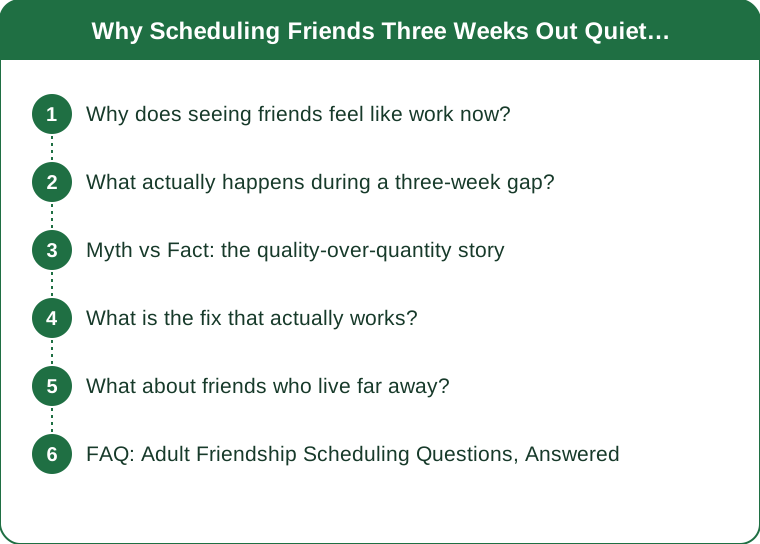
Why does seeing friends feel like work now?
Because you moved every interaction into the same category as obligations.
When the only way you see someone is a two-hour block booked twenty-three days in advance, that block inherits everything a calendar event carries: preparation, travel logistics, the guilt of rescheduling, and the pressure to make it worth the coordination. Nobody schedules three weeks out for something disposable.
The math is unforgiving. If you see four close friends once every six weeks each, that is roughly 35 hours of friendship a year per person. Research on closeness consistently points to accumulated hours of casual contact — not intensity of individual meetings — as the thing that moves acquaintances toward close friends and keeps close friends there.
The long lead time also creates a selection effect. Only the plans important enough to survive three weeks of life get booked. Everything smaller — a twenty-minute walk, a coffee because you were nearby, a phone call while folding laundry — never enters the system at all, because it does not feel worth a calendar invite. Those small contacts are precisely the ones that make friendship feel effortless.
What actually happens during a three-week gap?
The relationship goes quiet in a specific way that neither person notices.
During the wait, you both accumulate life. By the time you sit down, you are not continuing a conversation — you are delivering a summary. Most of the two hours goes to status reporting: the job thing, the family thing, the health thing. You catch up, and then it is time to go.
Catching up is not the same as connecting. Summary mode is inherently past-tense and slightly performative. You choose which parts of three weeks to narrate, which means you are editing. The unedited stuff — the small irritation on Tuesday, the thing you found funny, the half-formed worry — never makes it, because it does not survive the edit.
This is why a friendship can be technically active and still feel distant. You are seeing each other. You are just never catching each other in the middle of anything.
Myth vs Fact: the quality-over-quantity story
Myth: A few deep, meaningful conversations a year matter more than frequent casual contact.
Fact: Both matter, but frequency is what makes depth possible. Deep conversations do not usually happen on demand in a scheduled two-hour block — they happen in the third hour of an unstructured afternoon, or on a walk when nothing was supposed to happen. Frequency creates the surface area where depth occurs.
Myth: Busy adults simply cannot see friends more often.
Fact: Most people cannot see friends more often in two-hour scheduled blocks. Almost everyone has capacity for a ten-minute call, a shared errand, or a walk that overlaps with something they were doing anyway. The constraint is the format, not the friendship.
Myth: If you have to schedule it, the friendship is already in trouble.
Fact: Scheduling is fine and often necessary. The problem is when scheduling is the only channel. A friendship running on one channel is fragile — one cancellation and you are six weeks out.

What is the fix that actually works?
Add a second tier. Keep the scheduled dinners, but stop asking them to carry the relationship alone.
Tier one: the anchor. One planned, calendar-worthy meeting every four to six weeks. This is what you already do. Keep it.
Tier two: contact that needs no calendar. Aim for two or three touches a week, each under fifteen minutes. Specifically:
- The overlap invite. You are already doing something — a grocery run, a walk, a laundry cycle. Invite someone into it. “Walking the loop at 7, come if you want” costs nothing if they decline.
- The voice memo. A ninety-second recording beats a paragraph of text because tone carries. It is also asynchronous, so neither person has to be free at the same moment.
- The specific callback. Not “how are you” — that gets “good, you?” Ask about the exact thing they mentioned last time. “Did the landlord ever fix the heat?” gets a real answer.
- The standing slot. Same day, same time, every week or two, no confirmation needed. Standing plans survive because they cost zero coordination.
Lower the bar for what counts. A friendship does not require a plan. It requires contact.
What about friends who live far away?
Distance removes the overlap invite, which is the cheapest tool. Everything else still works, and one thing works better.
Asynchronous beats synchronous across time zones. Two people trading voice memos across a five-hour difference will talk more in a month than two people trying to find a mutual free evening. Stop trying to schedule the video call and start leaving messages.
Share the boring stuff on purpose. The photo of what you are cooking. The thing on the train. Long-distance friendships fail because both people save up material for the quarterly call, which turns every conversation into a press briefing. Sending the unimportant thing is what makes it feel current.
Accept a different rhythm rather than a lesser one. A far-away friendship built on daily small contact is not a downgrade from a local one — it is often more verbal, more detailed, and more consistent than a local friendship running purely on scheduled dinners.
FAQ: Adult Friendship Scheduling Questions, Answered
Is it rude to invite someone last minute?
No, as long as the invitation is genuinely low-stakes and the decline is genuinely free. “I’m at the park for another hour if you’re around” is not a demand. The rudeness people fear comes from last-minute invitations that carry obligation — this kind does not.
What if my friend never initiates?
Check whether they initiate in a different format. Plenty of people who never propose plans will answer every voice memo within an hour. Uneven initiation on plans is common and does not automatically mean uneven investment — but if there is no reciprocity in any channel over a few months, that is worth naming directly.
How many close friends can this realistically support?
Three to five in the frequent-contact tier is a common ceiling for most people with jobs and families. Beyond that, contact naturally drops to the scheduled tier. That is normal, not a failure — most people’s inner circle sits in that range.
TL;DR:
- Long lead times filter out the small, casual contact that actually builds closeness.
- Three-week gaps turn conversations into status summaries, which feels like reporting, not connecting.
- Keep the scheduled anchor every four to six weeks, but add a second tier of two or three sub-fifteen-minute touches a week.
- Overlap invites, voice memos, specific callbacks and standing slots all cost almost nothing.
- For long distance, asynchronous beats synchronous — and sending the boring stuff is the point.
You do not need more time for your friends. You need a version of friendship that fits in the time you already have, sitting alongside the dinners rather than waiting three weeks for them.
Keep Reading
This article is for general informational and styling purposes only. Fit, sizing, and product availability may vary.