Why Group Chats Go Quiet in August (and How to Restart One Without Being Weird)
Quick Answer: August group-chat silence is structural, not personal: staggered vacations break the conversational rhythm, the shared schedule that generates common material dissolves, and chat momentum is self-reinforcing in both directions - silence normalizes silence exactly as chatter normalized chatter. The revival playbook avoids the two classic failures (the guilt-trip “dead chat lol” and the demanding open-ended question) and uses what works: a specific artifact - a photo, a memory callback, a found object that belongs to the group’s private mythology - or a low-stakes poll, followed within days by a date-attached plan. September’s returning rhythm will do half the work; your one good message does the rest.
Three weeks of nothing, then someone posts a sunset, gets two hearts, and the silence resumes. Everyone in the chat has noticed. Everyone assumes everyone else is busy, annoyed, or drifting. Almost always, nothing is wrong at all - August is just running its annual experiment on the group’s operating system.

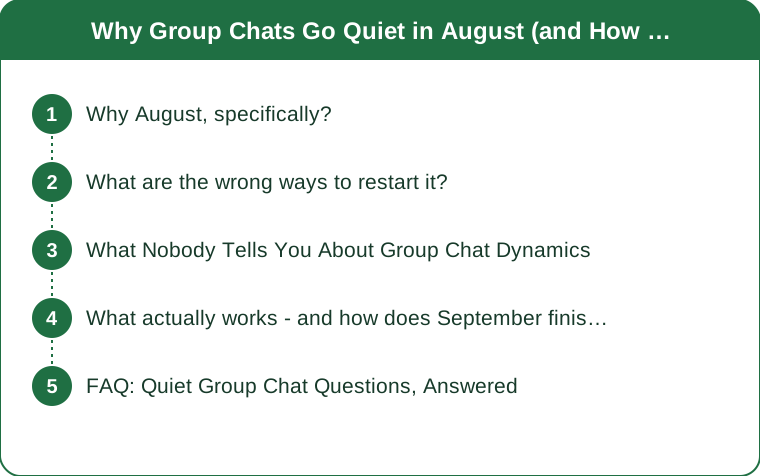
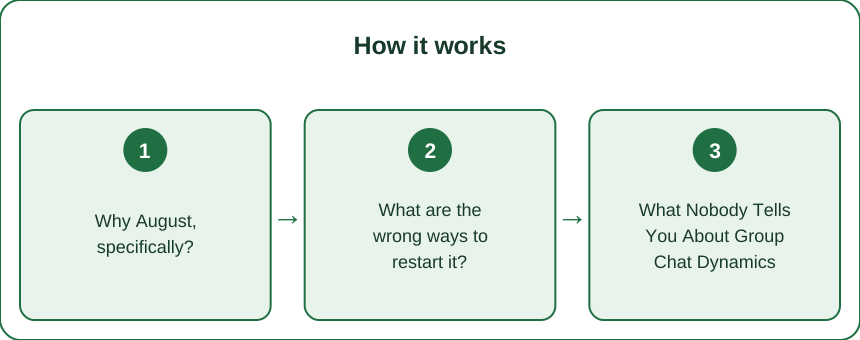
Why August, specifically?
Four seasonal mechanics, none of them about affection.
Staggered absence breaks the rhythm without ever emptying the room. A group chat runs on conversational tennis - remark, reply, riff - and it survives one person’s vacation easily. But August staggers everyone’s time away across different weeks, so at any given moment someone key is off-grid, replies land a day late, threads die mid-riff, and the tennis becomes serve-and-silence. No single absence killed it; the overlap pattern did.
The shared schedule - the chat’s raw material - dissolves. School-year and work-rhythm life generates automatic common ground: the same Monday dread, the show everyone watches, the weekend everyone is planning for. August atomizes the group into different beaches, different guests, different time zones - and experiences too parallel to riff on. “We are at the lake” is lovely and conversationally inert; nothing in it needs answering.
Momentum is the physics layer under both. An active chat gives every member three reasons a day to check it and low stakes for tossing in a half-thought. A quiet chat raises the bar: after two silent weeks, any message feels like it needs to justify the interruption, so drafts get typed and deleted, and each silent day raises the bar further. This loop - not anyone’s feelings - is what converts a slow fortnight into a dead month.
And August is peak life-noise. Trips to execute, kids home and feral, work compressed around colleagues’ absences, the pre-September scramble. The bandwidth that fed the chat is genuinely spoken for - which is worth naming because the silence reads as social signal when it is mostly logistics.
The reframe that lowers the revival stakes: nobody left. The room is full of people waiting for someone else to make re-entry feel normal - which means the first good message is a public service, not an imposition.
What are the wrong ways to restart it?
Four well-intentioned moves that reliably land badly.
The guilt-trip revival: “wow, dead chat,” “so nobody talks anymore lol.” It names the silence while adding nothing to break it, assigns collective blame with a joke’s deniability, and hands everyone a small chore of reassurance. The predictable yield: two defensive emojis and a deeper silence, because now the quiet has been made awkward officially.
The oversized open-ended question: “how IS everyone??” Kindly meant, but it invites each person to summarize a month - which is homework - and answering second means measuring your update against the first. High effort, unclear turn-taking, easy to scroll past while telling yourself you will answer properly later. Later never files its reply.
The wall-of-text personal update. Dropping four paragraphs of your own August into a silent room reverses the homework: now everyone owes a proportional response or feels rude reading in silence. Long updates are for the phone call or the reunited dinner - chat revival needs something answerable in eight seconds.
And the instant event push: breaking silence with a scheduling grid. A plan is the goal, but as the opening move it asks a cold room for calendar commitments - the highest-friction ask in group life - before anyone has warmed up. Watch the mechanics: polls about nothing get answered; polls about attendance, from a silent start, get seen-zoned while people wait to learn who else is in.
The common thread in all four failures is stakes management. Each one makes the first reply expensive - emotionally, socially, or logistically. The moves that work, next section, all share one design principle: the first reply should cost nothing and mean something.

What Nobody Tells You About Group Chat Dynamics
Every chat has an engine, and the engine is allowed to rest. One or two people generate most conversation starts in almost every group - remove them (vacation, busy season, or just tired of the role) and the chat idles regardless of everyone else’s affection. If you are the engine, know that August silence reflects your August, not the group’s health. If you are not, an occasional start is the most appreciated contribution you can make - the engine notices who else ever turns the key.
Read-without-replying is participation - genuinely. The lurkers are not absent: they are keeping current, laughing silently, and staying attached. Chat platforms just render their attendance invisible. Many a quiet member considers the group chat a vital connection while posting quarterly - worth remembering before diagnosing drift from reply counts.
Chats have lifespans, and endings are not failures. The chat born for a wedding, a trip, a project, or a life phase can complete its purpose. Some August silences are actually gentle conclusions - and the friendships continue in other channels, undamaged. The distinguishing test: does the silence feel like tension, or like a finished book? Finished books do not need CPR.
The side-text is the master key. The highest-leverage revival move happens outside the group entirely: text the one member you talk to most - “should we wake the chat up? you in if I post something?” - and re-enter with a guaranteed first replier. Two-voice momentum in the first hour is what tips a revival from awkward to warm, and manufacturing it is completely legitimate stagecraft.
And shrinking is not dying. Sometimes the eight-person chat quiets because the real energy lives in a three-person subset. The subset chat’s existence is not betrayal - it is friendship finding its natural clusters. The big chat keeps its purpose for the whole constellation’s news and reunions; the small one carries the daily texture. Most healthy long friendships run on exactly this two-tier architecture without anyone ever declaring it.
What actually works - and how does September finish the job?
The revival playbook, in order of reliability.
Move one: the artifact. A photo from the group’s shared history (“found this from the cabin trip and yelled”), a meme squarely inside the group’s private humor, a sighting of the group’s running joke in the wild - anything that references the collective mythology. It requires no update, no homework, no calendar; the reply costs one emoji and the door is open. This is the single most reliable cold-chat opener there is, because it reminds the room what the room is for.
Move two: the low-stakes poll. A genuine tiny question with option-letter answers: rating a trend, settling a food debate, choosing between two absurd hypotheticals. Answerable in five seconds, turn-taking obvious, and disagreement - the lifeblood of chat - practically guaranteed. The poll is warm-up machinery: it exists to produce twelve messages of nothing, which is what a chat’s engine runs on.
Move three, within the week: the date-attached plan. Once the room is warm - and only then - convert: one concrete proposal with a date and a low bar. “First Friday after school starts, usual patio, 7pm - who is in?” beats every “we should get together soon” ever typed, because it can be answered with a single word and survives two people declining. August-ending plans have a special tailwind: everyone privately wants a bookend before the season turns.
Then let September do its half. The school-and-work rhythm that returns after Labor Day rebuilds the shared schedule automatically - common material regenerates, check-in habits resume, and chats that survived August in hibernation typically wake on their own by mid-September. Your revival message is not fighting the season; it is meeting the turn a few weeks early and claiming the credit.
And consider giving the chat one small standing structure for next year: a monthly anything - first-Sunday photo dump, a rotating dinner, the fantasy league, an annual trip-planning thread that starts each August. Standing rituals are silence insurance: they schedule the revival so nobody has to perform it. The chats that never quite die all have one; the August test is how the rest of us find out we should too.
FAQ: Quiet Group Chat Questions, Answered
Why did our group chat suddenly go quiet over the summer?
Almost certainly structure, not feelings: August staggers everyone’s vacations so threads keep dying mid-conversation, dissolves the shared schedule that generates common material, and lets chat momentum - which is self-reinforcing in both directions - wind down. Add peak seasonal busyness, and silence becomes the default nobody chose. It says nothing about the friendships.
How do I revive a dead group chat without being awkward?
Open with an artifact - a photo or callback from the group’s shared history - or a five-second poll, never with “dead chat lol” or “how is everyone??”, both of which make replying expensive. Line up a guaranteed first responder by side-texting one member beforehand. Once a little banter runs, convert within the week to one date-attached, one-word-answerable plan.
Is it normal for friends not to text all summer?
Entirely - adult friendship rhythm is seasonal, and summer scatters routines that communication rides on. Read-without-replying members are still participating, and a quiet August predicts nothing about fall. The friendships that need attention are the ones that stay silent after the shared rhythm returns in September, not the ones that napped through the vacation shuffle.
Should every quiet group chat be revived?
No - some chats complete their purpose (the wedding, the trip, the old job) and end as finished books rather than failures, with the friendships continuing elsewhere. The test is whether the silence feels tense or simply concluded. Revive the ones that still have a reason to exist; give the completed ones a grateful retirement and keep the people.
TL;DR:
- August silence is mechanical: staggered vacations break the rhythm, shared schedules dissolve, and quiet compounds exactly like chatter did.
- The failed openers make replying expensive: guilt jokes, giant open questions, text walls, and cold scheduling grids.
- What works: an artifact from the group’s mythology or a five-second poll - with a side-texted first replier arranged.
- Convert warmth to a date-attached plan within the week; one word should be enough to RSVP.
- September rebuilds the shared rhythm automatically - and a monthly ritual is silence insurance for next August.
Nobody left the room; everyone is just waiting for re-entry to feel normal. One artifact and one plan, and the season’s experiment on your friendships concludes the way it always should have.
Keep Reading
This article is for general informational and styling purposes only. Fit, sizing, and product availability may vary.