Why Your Friendships Need Renegotiating in September, Not Just Rescheduling
Quick Answer: Summer friendships run on spontaneity and long open evenings. September removes both, and the mistake is trying to fit the same kind of plans into a smaller calendar. What survives is a different shape entirely: shorter and more frequent, attached to things you are already doing, and with a standing slot rather than a fresh negotiation each time. The research on relationship maintenance consistently favours frequency over duration.
The single change that helps most: replace “we should catch up soon” with a recurring slot, even a small one.
This is general information rather than medical advice.

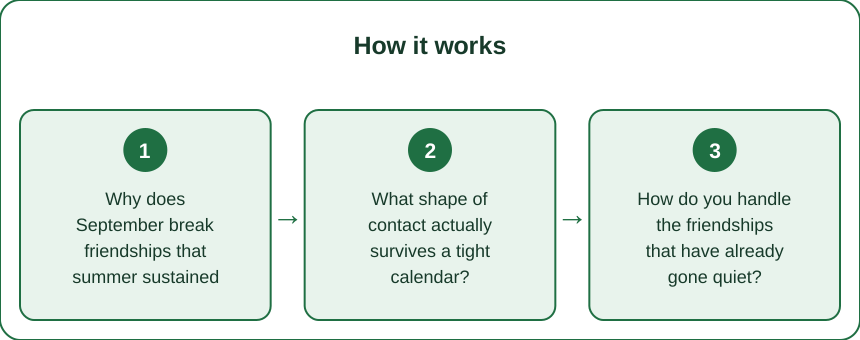
Why does September break friendships that summer sustained easily?
Because the mechanism that was maintaining them has been removed, and nobody replaced it.
What summer supplied invisibly:
- Long evenings, which made a spontaneous meet-up possible without planning
- Flexible schedules, so two people’s free time overlapped often
- Shared context - holidays, outdoor spaces, events - which meant plans formed around things already happening
- Low coordination cost. Deciding to see someone required almost no negotiation
What September replaces it with. A fixed schedule, dark evenings, and a coordination problem that grows with the number of people involved. Getting three or four adults into the same room now takes weeks of scheduling.
The three-weeks-out trap. When a plan requires three weeks of lead time, it is competing against three weeks of things that might come up - and the odds of cancellation rise with the notice period. Plans that get scheduled far ahead get cancelled more, which is not intuitive and is well recognised.
The reciprocity stall. After a cancellation, someone has to reinitiate, and nobody wants to be the one who always does. A single cancelled plan in September frequently turns into a three-month gap, without any decision by either person.
Why it feels personal and usually is not. Both people experience the same schedule compression, and both interpret the other’s unavailability as a signal about the friendship. The literature on relationship maintenance suggests decay is far more often about logistics than about feeling, which is worth knowing when interpreting a quiet month.
The size of the effect. Research on friendship consistently finds that frequency of contact predicts closeness more strongly than the length of individual interactions. Which means the September problem - fewer, longer, harder-to-schedule meet-ups - is precisely the wrong adaptation.
What shape of contact actually survives a tight calendar?
Shorter, more frequent, attached to existing activity, and pre-scheduled rather than negotiated.
Shorten the unit.
- A 40-minute coffee is far easier to schedule than a 3-hour dinner, and the research suggests it does comparable work for closeness
- A 15-minute phone call on a commute counts more than people think
- Voice notes, which are asynchronous and considerably warmer than text
Attach it to something you are already doing.
- Walking somewhere you were going anyway
- The same gym class, or a shared errand
- This is the highest-yield adaptation, because it costs no additional time - only a change in how existing time is spent
Make it recurring rather than negotiated.
- A standing slot - first Tuesday, every other Thursday morning - removes the coordination cost entirely
- The negotiation is what fails, not the meeting. A recurring slot only needs deciding once
- A missed instance does not need rescheduling, because the next one is already in place. This is the property that makes it robust
Reduce the group size.
- Coordinating two people is easy; four is exponentially harder
- Two one-on-one coffees will actually happen where one group dinner will be rescheduled twice and then quietly abandoned
Lower the bar for what counts.
- A five-minute call is contact. A photo with a sentence is contact
- The alternative is not a better interaction - it is no interaction, which is the comparison that matters
Kill the phrase “we should catch up soon.” It feels like an offer and functions as a closing. Replace it with a specific proposal or a standing slot, which is the single most useful sentence-level change available.

How do you handle the friendships that have already gone quiet?
Reinitiate without accounting for the gap, and lower what you are asking for.
On the gap itself.
- Do not open with an apology or an audit of how long it has been. It creates an obligation to respond in kind and makes the exchange about the gap rather than about the person
- “This made me think of you” plus the thing is close to the ideal opener - specific, requires no response, and carries no obligation
- Most people are relieved rather than resentful. Both parties usually feel equally responsible, which is worth remembering before assuming you are the one who let it lapse
Lower the ask.
- A 30-minute coffee rather than dinner. A short call rather than a visit
- A small ask is easier to say yes to and it restarts the pattern, which is what you actually want
On the awkwardness of the first contact after a long gap. It is real, it is brief, and it is almost entirely on the initiator’s side. The recipient generally experiences it as a nice surprise rather than as an awkward one.
Deciding which friendships to actively maintain, which is a legitimate thing to do:
- Capacity for close relationships is genuinely limited, and a tight schedule means choosing rather than failing
- Choosing deliberately is better than letting the calendar choose, which is what happens by default
- Some friendships are seasonal or contextual, and letting one rest is not a failure. Some of them resume years later without difficulty
On the friendships that are worth the effort. The ones where you feel better afterwards rather than more tired, where the conversation resumes rather than restarts, and where neither person is keeping score. Those are the ones to put a standing slot in the calendar for.
When to be concerned rather than practical. If withdrawal from all social contact is accompanied by persistent low mood, loss of interest, or exhaustion that rest does not fix, that is worth talking to a doctor about rather than treating as a scheduling problem.
Myth vs Fact: Friendship and Busy Seasons
Myth: Real friendships do not need maintenance. Fact: All relationships decay without contact. Frequency of contact is one of the strongest predictors of closeness, and expecting a friendship to survive on its own is the belief that ends most of them.
Myth: Longer meet-ups are better than short ones. Fact: Frequency predicts closeness more strongly than duration. Four 40-minute coffees beat one long dinner, and they are far more likely to actually happen.
Myth: Scheduling friendship makes it transactional. Fact: A recurring slot removes the coordination cost that is actually killing the friendship. Spontaneity is a luxury of an open calendar, and pretending otherwise means seeing nobody.
Myth: If they wanted to see me they would reach out. Fact: Both people are usually thinking exactly this. Reciprocity stalls are a coordination failure, not a signal about feeling, and one person breaking the stall usually resolves it immediately.
Myth: You should apologise for a long silence. Fact: Opening with an apology makes the exchange about the gap and creates an obligation. “This made me think of you” works far better and requires nothing in return.
Myth: A cancelled plan should be rescheduled immediately. Fact: Rescheduling is where plans die, because it restarts the negotiation. A standing slot means a missed instance needs no rescheduling at all - the next one already exists.
FAQ: Keeping Friendships Through a Busy Season, Answered
Why do friendships fade in autumn?
Summer supplied long evenings, flexible schedules and low coordination cost. September removes all three, and plans that need three weeks of notice get cancelled far more often than plans made a day ahead.
What is the single most effective change?
Replace ad hoc planning with a standing slot. The negotiation is what fails, not the meeting, and a recurring slot only needs deciding once.
Is a short coffee really enough?
Yes. Research on friendship consistently finds frequency predicts closeness more strongly than duration, and a 40-minute coffee that happens beats a long dinner that gets rescheduled.
How do I reach out after months of silence?
Send something specific that made you think of them, with no apology and no accounting for the gap. It requires no response and carries no obligation.
Should I feel bad about letting some friendships rest?
No. Capacity for close relationships is genuinely limited, and choosing deliberately is better than letting a calendar choose for you. Some friendships resume years later without difficulty.
What if I have no energy for any of it?
If withdrawal comes with persistent low mood, loss of interest, or fatigue that rest does not fix, that is worth raising with a doctor rather than treating as a scheduling problem.
TL;DR:
- Summer maintained friendships through spontaneity, and September removes the mechanism rather than the desire
- Frequency beats duration - four short coffees do more than one long dinner and are far likelier to happen
- A standing slot removes the coordination cost that is actually killing the plan
- Attach contact to things you are already doing; it is the only version that costs no extra time
- Reach out without apologising for the gap - “this made me think of you” needs no response
The plans did not stop because anyone stopped caring. They stopped because the thing that used to make them easy quietly disappeared in August.
Keep Reading
This article is for general informational and styling purposes only. Fit, sizing, and product availability may vary.