Why Friendships Formed Through a Shared Activity Survive Differently
Quick Answer: Friendships built around a recurring shared activity have a built-in mechanism that friendships based on individual arrangement do not: the meeting happens whether or not anyone organises it. That makes them remarkably durable during busy periods and remarkably fragile when the activity ends. Knowing which type a friendship is tells you what it needs - activity friendships need one non-activity contact point, and arranged friendships need a recurring slot.
You have not organised anything with your Tuesday running friend in two years, and you see them every week.
You adore your old colleague and you have not managed a coffee since March.
Neither of those is about how much you like the person.

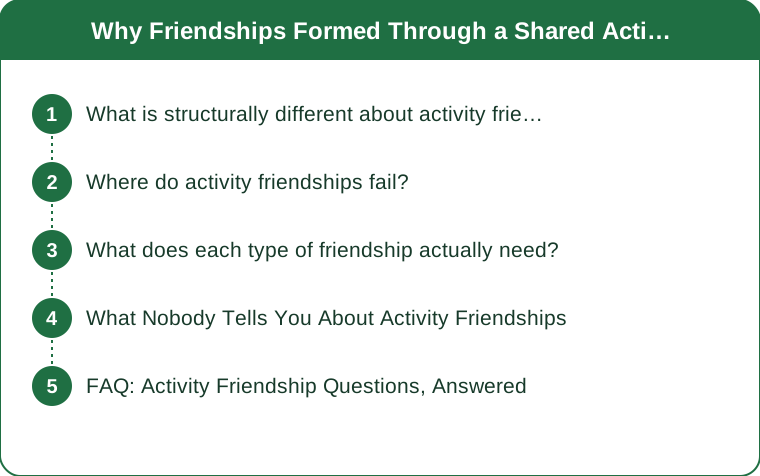
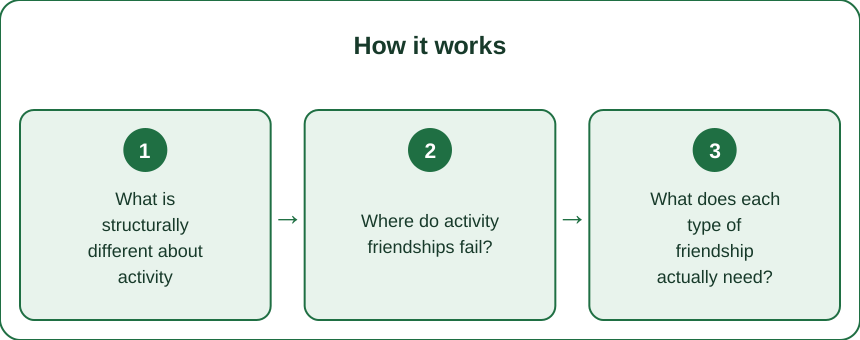
What is structurally different about activity friendships?
The meeting is not something anyone has to arrange.
In a friendship based on individual arrangement, every meeting requires a decision, a negotiation and a diary. Each of those is a point at which it can fail, and during a busy period all three get harder simultaneously.
In an activity friendship, the meeting is already scheduled by something outside the relationship. The class runs at 7pm on Tuesday whether or not either of you thought about it. You show up for the activity and the friendship happens as a by-product.
Which means the friendship survives periods when neither person has the capacity to organise anything - and those periods are exactly when arranged friendships quietly lapse.
There is a second structural advantage: shared context. You have something to talk about that is not catching up, which lowers the effort of the interaction itself. Catching up after a long gap is genuinely effortful, and it is a common reason people avoid arranging things with friends they like.
And a third: frequency without intensity. Seeing someone briefly every week builds familiarity in a way that a three-hour dinner twice a year does not, even though the second involves more total time.
None of this is about depth. Activity friendships can be shallow or profound. The structural point is about persistence, which is a different variable entirely.
Where do activity friendships fail?
When the activity stops, and it happens faster than people expect.
The whole advantage runs through the activity, so removing the activity removes the mechanism. If one person leaves the club, changes schedule, gets injured or moves, the friendship frequently ends within a couple of months despite genuine mutual liking.
Why it happens so fast: neither person has ever practised arranging to meet. The skill and the habit were never needed, and building them at the moment the structure disappears is much harder than it sounds.
The common pattern:
- Someone stops attending
- Both people intend to arrange something and neither does
- The window in which it would feel natural closes within about two months
- After that it requires an explicit gesture, which feels disproportionate to a friendship that never involved gestures
Autumn is a high-risk period for this specifically. Term restarts, schedules change, evening classes shift and outdoor activities move or stop. A lot of activity friendships quietly end in September and October without either person deciding anything.
The preventive step is small and has to happen before it is needed: one contact point outside the activity. A message thread, a phone number, anything. If the only way you reach this person is by both being in the same room on Tuesdays, the friendship has a single point of failure.

What does each type of friendship actually need?
The opposite of what it already has.
Activity friendships need one non-activity connection.
- Exchange contact details early, before there is a reason to need them
- One thing outside the activity a couple of times a year - a coffee after, a walk, anything that establishes the friendship exists independently
- When either person’s circumstances change, make contact within the first fortnight. The window is much shorter than people assume
Arranged friendships need a recurring slot.
- A standing arrangement beats an intention. First Sunday of the month, or a monthly call at a fixed time
- Recurring beats occasional even at lower total contact. A short monthly call sustains a friendship better than an intended long dinner that keeps moving
- Lower the bar for what counts. A twenty-minute walk is a legitimate meeting, and treating only long meaningful catch-ups as real is why they stop happening
A note on the scheduling trap: arranging things far in advance feels responsible and quietly weakens a friendship. A meeting three weeks out is easier to cancel and removes the possibility of spontaneous contact in the meantime. Shorter horizons, lower stakes, more often.
And the genuinely useful move for both types: convert one arranged friendship into an activity one. Find something you both do anyway - a class, a walk, a regular swim - and the maintenance problem solves itself.
What Nobody Tells You About Activity Friendships
Five observations that change how you treat them.
Frequency beats duration for building closeness. Brief regular contact accumulates familiarity more effectively than infrequent long meetings, which is why the person you see for fifteen minutes weekly can feel closer than the friend you have dinner with twice a year.
You often know less about them than it feels like. Activity friendships can run for years without covering basic biography, because the shared context always provides something else to talk about. This is not a problem until the activity ends and there is nothing to fall back on.
The two-month window is real and short. When someone leaves the activity, contact within the first few weeks usually preserves the friendship and contact after two months usually feels like a gesture. Knowing the window exists is most of the value.
Autumn is when they die. Schedule changes, term restarts and activities moving indoors or stopping all cluster in September and October. If you have an activity friend whose schedule just changed, this month is the month to send the message.
They are underrated as a solution to adult friendship generally. The most common complaint about making friends as an adult is that it requires organising, and activity friendships are the category that does not. Joining something recurring is a more effective strategy than trying harder to arrange things with people you already know.
FAQ: Activity Friendship Questions, Answered
Are activity friendships less real than other friendships?
No - they are structurally different, not shallower. Depth varies enormously in both types. What differs is the mechanism keeping them going, and activity friendships have a stronger one right up until the activity ends.
My gym friend changed their schedule. Is it too late?
If it has been a few weeks, no - send a message now. The window in which contact feels natural is roughly two months, and after that it requires a more deliberate gesture, which many people avoid making.
How do I move an activity friendship outside the activity?
Suggest something adjacent and low stakes - a coffee after the session, a walk at the weekend. Adjacent is easier than a formal social invitation, which can feel like an escalation neither person asked for.
Why do I lose touch with people I genuinely like?
Usually structure rather than feeling. Friendships that require arranging fail during busy periods, when arranging is hardest. Adding a recurring slot addresses the actual cause rather than trying to want it more.
Is it worth joining something just to make friends?
It is one of the more effective approaches available to adults, because it removes the organising problem that stops most adult friendships forming. Recurring and consistent matters more than what the activity is.
Why does autumn feel harder for friendships?
Schedules restart, activities move or stop, and evenings get darker and busier all at once. A lot of activity friendships lapse in September and October without anyone deciding to end them.
TL;DR:
- Activity friendships persist because the meeting is scheduled by something outside the relationship
- They fail fast when the activity ends, because neither person ever practised arranging to meet
- The window to reconnect after someone leaves is roughly two months
- Give every activity friendship one contact point outside the activity, before you need it
- Arranged friendships need a recurring slot - short and regular beats long and occasional
- Arranging things three weeks out is easier to cancel and quietly weakens the friendship
- Converting an arranged friendship into an activity one solves the maintenance problem permanently
Autumn is when activity friendships quietly end. If someone’s schedule just changed, this is the month to message them.
Keep Reading
This article is for general informational and styling purposes only. Fit, sizing, and product availability may vary.