Why Catching Up Every Six Months Gets Harder Each Time
Quick Answer: Long-gap catch-ups get harder because the format forces summary instead of presence. With six months to cover, you spend the conversation reporting headlines - job, house, health - rather than sharing anything in progress. Summary is exhausting and it does not build closeness, because closeness comes from shared small moments, not updates. The fix is not longer meetings but shorter, lower-stakes contact in between.
You finally get the date in the diary. It is lovely. And somewhere around the ninety-minute mark you notice you have been giving a presentation about your own life to someone who used to know it as it happened.

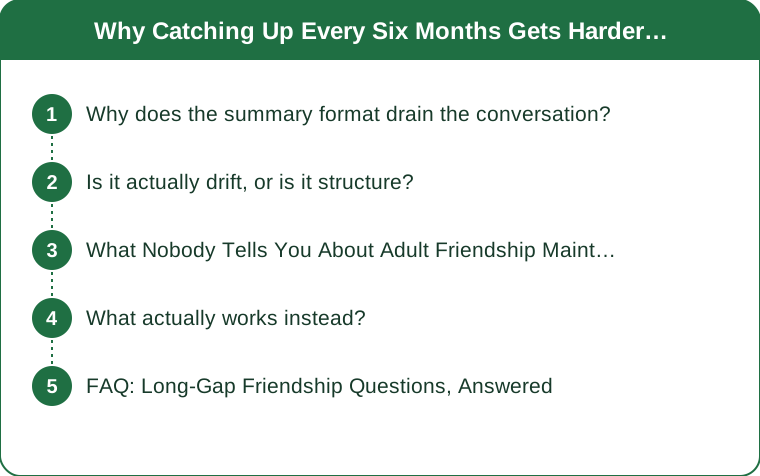
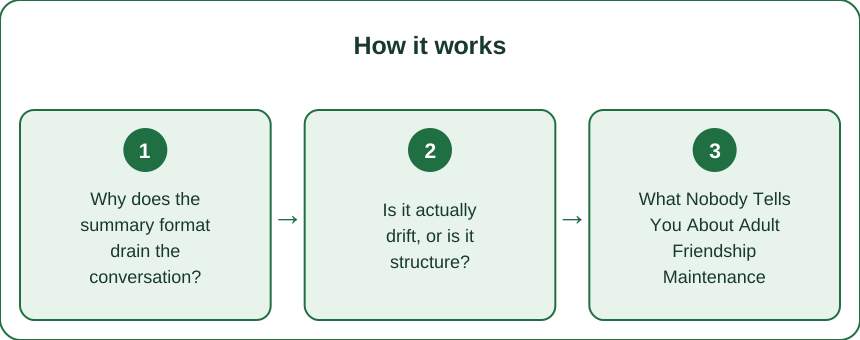
Why does the summary format drain the conversation?
Because it converts a relationship into a report, and reports have no room for the things friendship actually runs on.
Six months of material forces compression. You have to choose what is important enough to mention, which means everything unresolved, ambiguous, or small gets cut. Those are exactly the things you would have told a close friend in real time.
Headlines are the least interesting version of a life. The interesting part was not that you changed jobs - it was the two weeks of deciding. By the time you meet, the deciding is over and only the outcome survives.
Both people are performing summaries at once. The conversation becomes two sequential monologues rather than an exchange, and the listening half is much harder work than it used to be.
And you end up briefing each other on context. A large share of a long-gap catch-up is spent re-establishing who people are, what the situation was, why it mattered. That context used to be shared, and rebuilding it consumes the time you meant to spend connecting.
Is it actually drift, or is it structure?
Usually structure. The relationship is intact; the mechanism that maintained it is not.
Proximity did most of the work in earlier friendships. School, university, a shared workplace, a shared neighborhood - closeness was a byproduct of repeated unplanned contact. Nobody scheduled it and it required no effort.
Adult friendship has no default. Once proximity ends, every single contact must be initiated by someone. This is a completely different maintenance cost, and it is why friendships that were effortless for a decade can fade in eighteen months.
Effort asymmetry creeps in quietly. Often one person initiates most of the time. That person eventually stops, not from resentment but from fatigue, and the friendship goes quiet in a way neither person chose.
Life stage divergence widens the gap. Different work patterns, different caring responsibilities, different geographies. These make scheduling harder, which extends the gap, which makes the next conversation more summary-heavy - a loop that feeds itself.
None of this means the friendship weakened. The regard is usually completely intact. What weakened is the frequency of contact, and frequency is a logistics problem, not an emotional one.

What Nobody Tells You About Adult Friendship Maintenance
Low-stakes contact matters more than high-stakes contact. A three-line message about something that reminded you of them does more for the relationship than a two-hour dinner six months later - because it keeps shared context alive, which is what makes the dinner easy when it happens.
Scheduling far ahead reduces contact rather than protecting it. A date three weeks out feels like the friendship is handled, so nothing happens in the meantime. The distant plan crowds out the near one.
Shoulder-to-shoulder beats face-to-face for some people. A walk, a task, a shared errand produces easier conversation than a table for two, where the format itself demands performance. If your catch-ups feel like interviews, change the setting before you change the frequency.
Voice notes carry more than text. Tone survives, and a 40-second voice note takes less effort than a well-composed message. A lot of friendships stay warm on voice notes alone.
The friend who seems fine is not necessarily fine. Long-gap catch-ups systematically underreport difficulty, because summarizing a hard six months to someone who was not there feels like too much to unload. The people you see least are the ones you know least about right now.
And nobody thinks you have forgotten them as much as you fear. The reason most people do not reach out is that they assume too much time has passed to be casual about it. Both sides are running the same calculation.
What actually works instead?
Shorten the interval and lower the stakes. In that order.
Send the small thing. The article, the photo, the two lines about something they would find funny. It requires no reply and it keeps the thread alive. This is the whole strategy in one habit.
Trade one long meeting for three short ones. A 20-minute call every six weeks maintains a friendship better than a four-hour dinner twice a year, because the conversation gets to be about now rather than about the last six months.
Make one thing recurring. A standing monthly walk, a shared show you both watch, a Sunday phone call. A recurring slot removes the scheduling negotiation, which is where most adult plans die.
Say the honest version. If it has been eight months, name it without apology and move on. The apology ritual eats the first twenty minutes and makes the gap feel like a fault, which makes the next gap harder to close.
And drop the reciprocity ledger. Some friendships have a permanent initiator and are perfectly healthy. If you are the one who reaches out, and you value the person, keep reaching out - the alternative is not fairness, it is silence.
Autumn is a good moment to restart one. The end of summer resets everyone’s calendar, which makes a message now less loaded than the same message in the middle of a settled routine.
FAQ: Long-Gap Friendship Questions, Answered
How often do you actually need to see a friend?
There is no fixed number, and it varies enormously by relationship. What matters more than frequency is that some contact - however small - happens between meetings, because that is what keeps shared context alive.
Is it rude to reach out after a very long silence?
Almost universally, no. Most people report being pleased to hear from someone after a long gap. The awkwardness is nearly always larger in the imagination of the person sending than in the reaction of the person receiving.
What if the catch-up feels one-sided?
Ask a smaller question. Long-gap conversations default to headlines because the question was broad - swap how have you been for something specific about a thing you already know they were dealing with, and the conversation usually shifts immediately.
Should I keep a friendship that only exists in twice-yearly dinners?
If you enjoy them, yes - not every friendship needs to be high-frequency. The question is only whether the format is the one you want, or the one that happened by default.
TL;DR:
- Long gaps force summary mode, and summaries are draining because they cut the small, unresolved things friendship runs on.
- Adult friendships lack the automatic proximity that maintained earlier ones - every contact now needs an initiator.
- Low-stakes contact between meetings does more work than the meeting itself.
- Trade one long dinner for three short calls, make one thing recurring, and skip the apology ritual.
The part most people get wrong is thinking the fix is a better meeting - a longer dinner, a weekend away, something that clears the backlog. It rarely works, because the backlog is not the problem. Two lines sent on a Tuesday for no reason will do more for a friendship than any scheduled evening, and it takes about eleven seconds.
Keep Reading
This article is for general informational and styling purposes only. Fit, sizing, and product availability may vary.