What to Say to a Friend Going Through Something Hard
Quick Answer: Say something specific rather than something perfect. I heard about your dad. I am so sorry beats a carefully composed message you never send. Then do three things: acknowledge without comparing, offer something concrete rather than asking what they need, and keep showing up after week two, which is when everyone else stops. The most common regret people report is not that a friend said the wrong thing - it is that a friend said nothing.
Almost everybody has been on the receiving end of this and knows what helped. Almost nobody applies that knowledge when they are on the other side, because the fear of getting it wrong is loud and the memory of what worked is quiet.

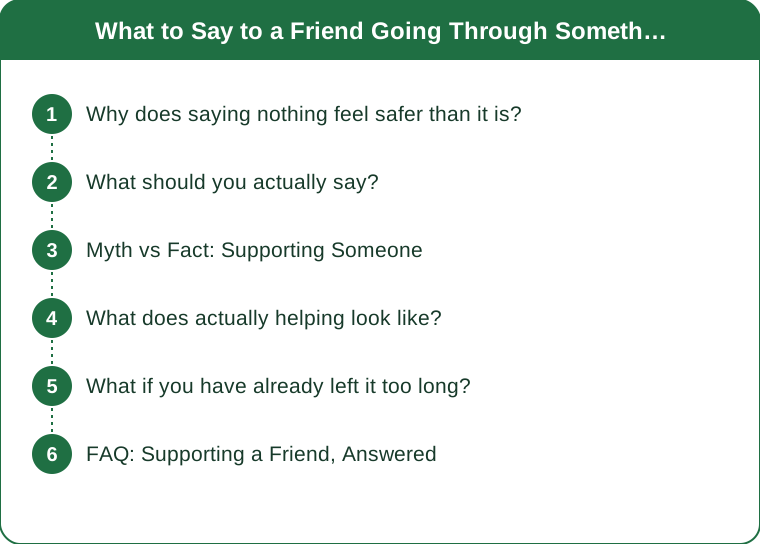
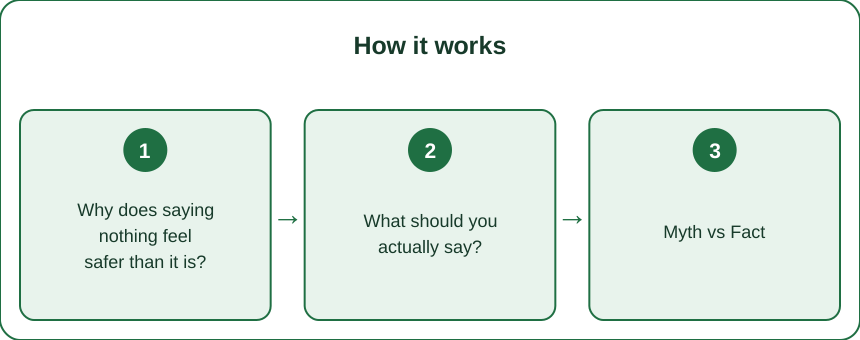
Why does saying nothing feel safer than it is?
Because the cost of a clumsy message is visible and the cost of silence is not.
If you send something awkward, you can imagine the moment it lands. If you send nothing, you imagine nothing happening. But something does happen - the person notices. Not immediately, and not with resentment usually, but the list of who reached out and who did not is one people remember for years.
The fear is also based on a wrong model of what helps. Most people assume the goal is to say something that makes the person feel better. It is not, and that goal is what produces the worst attempts - the silver linings, the comparisons, the advice.
The actual goal is much smaller: to make them feel less alone in it. That is achievable with a two-line message and it does not require you to be wise.
One genuinely useful reframe: you are not trying to fix anything, so there is very little to get wrong. The bar is presence, not eloquence. A short, plain, specific message from someone who cares clears it.
What should you actually say?
Short, specific, and without a request attached.
Name the thing. Vagueness reads as discomfort. I heard about your diagnosis is better than I heard you have been having a hard time. Naming it signals that they do not have to explain or manage your unease.
Say the plain thing. I am so sorry. That is awful. You do not need to improve on this.
Say what you are thinking, not what they should feel. I have been thinking about you all week works. Everything happens for a reason does not.
Take the reply pressure off. No need to reply to this is one of the most generous sentences available. Someone in crisis has a phone full of messages requiring responses.
Then, separately, offer one concrete thing. More on this below.
A workable template: I heard about X. I am so sorry - that is really hard. Thinking of you and no need to reply. I am going to drop some food round on Thursday, I will leave it on the step.
Four lines, no burden, and something actually happens.
Myth vs Fact: Supporting Someone
Myth: You should ask what they need. Fact: It sounds thoughtful and it hands them a task. Someone overwhelmed cannot generate a list of requests. Offer something specific instead: I am free Saturday morning, can I take the kids for two hours? They can say yes or no, which costs almost nothing.
Myth: Sharing your similar experience shows you understand. Fact: It moves the focus. My mum died too, I know exactly how you feel invites them to attend to your story. A brief I have been through something similar, I am here whenever you want to talk about it keeps the door open without walking through it.
Myth: You should avoid mentioning it in case you upset them. Fact: They are already thinking about it constantly. You are not reminding them. Not mentioning it makes them manage your discomfort as well as their own.
Myth: Silver linings help. Fact: At least it was caught early and everything happens for a reason consistently rank among the least helpful things people report hearing.
Myth: After a few weeks they will want to move on. Fact: Most people report the hardest period starts around week three, when the casseroles stop and everyone else’s life resumes.

What does actually helping look like?
Concrete, specific, low-obligation, and repeated.
Do a thing rather than offer to do a thing. Food left on a doorstep. A supermarket delivery ordered to their address. Their bins put out. Doing removes the decision, and decisions are what is in short supply.
Make offers with a defined shape. Can I walk your dog on Tuesdays for the next month? is answerable. Let me know if you need anything is not, and it quietly transfers the work to them.
Be the person for one specific thing. Trying to help with everything is unsustainable and it fades. Pick one - the school run on Wednesdays, a Sunday phone call, sitting with them at appointments - and be reliable about it.
Put a reminder in your phone for three weeks out, and again at three months. This is the single highest-value thing in this article. The support curve collapses after a fortnight, and a message at week five - thinking of you, no reply needed - lands in an emptier inbox than anything you sent in week one.
Remember dates. The anniversary, the scan date, the court date. Someone remembering the hard Tuesday is disproportionately meaningful.
What if you have already left it too long?
Send it anyway. This is almost never as bad as it feels.
The imagined reaction - where were you three months ago - is very rarely the real one. What people actually report is being glad to be thought of, and often relieved that someone has brought it up at a point when everyone else has moved on.
Acknowledge the gap briefly and without a long apology. I have been meaning to message for weeks and kept not knowing what to say, which is a rubbish reason. I am sorry about your dad and I have been thinking about you. One line. Do not make them reassure you about your delay - that is the trap that turns a late message into extra work for them.
Do not disappear again out of embarrassment. The most common pattern is a guilty silence that gets harder to break each week. Breaking it once resets it entirely.
And if it has been a year or more: it still works, particularly around an anniversary. I was thinking about you today, it must be a year about now. People consistently report that later messages, when the world has gone quiet again, are among the ones they remember most.
FAQ: Supporting a Friend, Answered
What if I genuinely do not know what happened?
Ask plainly and briefly: I heard something is going on - I do not want to pry, but I am here. People can fill in as much as they want.
Should I call or text?
Text first, almost always. A call demands they be ready to talk and to perform being okay. A text can be read at 2am and answered never.
What if they do not respond?
Assume nothing about it. Send another one a fortnight later with no reference to the silence. Non-response during a crisis is about capacity, not about you.
How do I support someone without burning out?
Be specific and bounded about what you can do, and be honest with yourself about it. Reliable and limited beats generous and disappearing. If you are also close to the situation, having your own person to talk to is not indulgent - it is what makes you able to keep showing up.
TL;DR:
- Say something specific, not something perfect. Name the thing, say you are sorry, and add no need to reply.
- Do not ask what they need - offer one concrete thing with a defined shape.
- Skip the silver linings and the comparisons. They rank among the least helpful things people hear.
- Set a reminder for week three and month three. That is when everyone else stops and when it matters most.
- If you have left it too long, send it anyway. Late almost always beats never, and one line covers the gap.
Nobody remembers the exact words. They remember who turned up, and they remember who was still there in November.
Keep Reading
This article is for general informational and styling purposes only. Fit, sizing, and product availability may vary.