The Right Way to Reconnect With a Friend You Lost Touch With
Quick Answer: The most effective way to reconnect is a short, warm, low-pressure message that references something specific and doesn’t over-apologize for the silence — something like ‘thinking of you, saw this and it reminded me of you’ works better than a long explanation of why you disappeared.
Most people avoid reconnecting with old friends because the silence itself starts to feel like the barrier, when in reality, most friendships survive gaps far better than we assume.

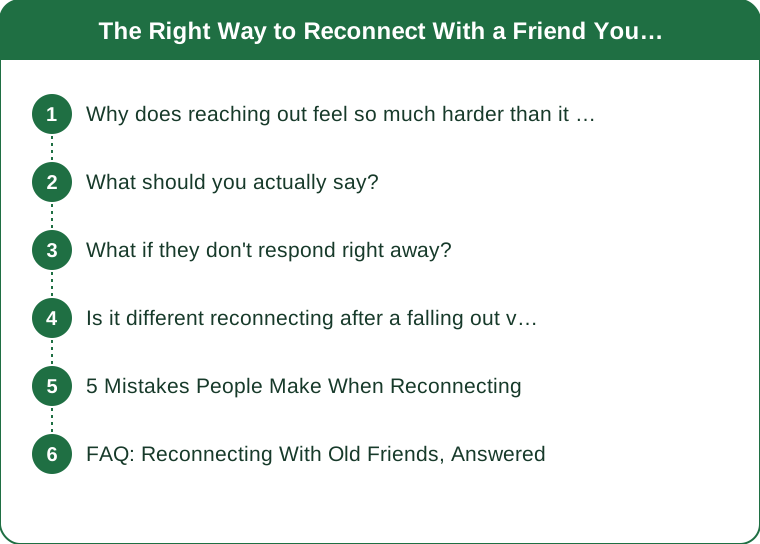
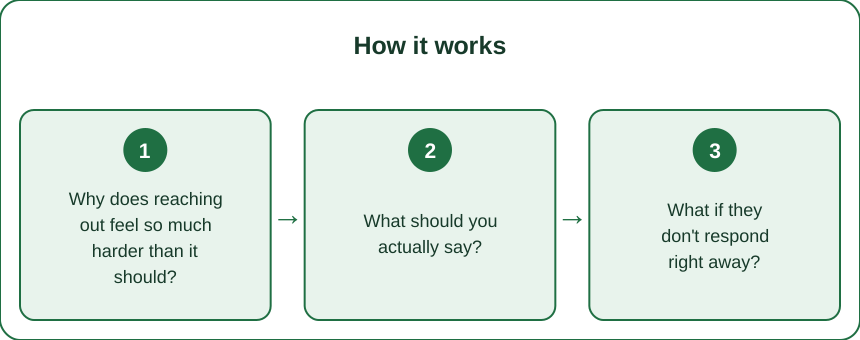
Why does reaching out feel so much harder than it should?
The longer the gap, the more your brain frames reaching out as a big event requiring a big explanation. In reality, most people on the receiving end don’t experience the silence the same way — they’re often just glad to hear from you, without needing a justification for the time that’s passed.
What should you actually say?
Skip the lengthy apology for going quiet — it puts pressure on the other person to reassure you, which can make the message feel more like a task than a genuine hello. A short, specific message works best: mention something that reminded you of them, ask one easy question, and leave the door open without demanding an immediate deep response.
What if they don’t respond right away?
Give it real time — a week or two of silence isn’t rejection, it’s often just life. People forget to reply to warm, low-pressure messages far more often than they intentionally ignore them, especially if the message doesn’t feel urgent.

Is it different reconnecting after a falling out versus just drifting apart?
Yes — drifting apart usually needs nothing more than a warm reopening message, since there’s no specific issue to address. A falling out typically needs a brief, honest acknowledgment before moving forward, even just one sentence, so the reconnection doesn’t feel like it’s pretending nothing happened.
5 Mistakes People Make When Reconnecting
Mistake 1: Over-explaining the silence. A paragraph justifying why you didn’t reach out sooner shifts the focus from reconnecting to self-defense, and it often makes the other person feel obligated to comfort you instead of just responding naturally.
Mistake 2: Leading with a big ask. Reaching out for the first time in years with a favor request (even something small) reads as transactional. Reconnect first, ask later.
Mistake 3: Waiting for the ‘perfect’ moment. There’s no ideal time that makes reaching out less awkward — waiting usually just extends the gap.
Mistake 4: Sending a mass message instead of something personal. A generic ‘long time no talk!’ sent to a group feels impersonal. One specific detail makes the message land differently.
Mistake 5: Expecting the friendship to instantly feel the same. It usually takes two or three real conversations to rebuild the ease that used to be automatic — expecting instant closeness sets up disappointment.
FAQ: Reconnecting With Old Friends, Answered
How long is too long to reach out?
There’s no expiration date. People reconnect successfully after five, ten, even twenty years — the specific message matters more than the time gap.
Should you reconnect over text or call?
Text first, almost always — it lets the other person respond on their own time without the pressure of an unexpected call, especially after a long gap.
What if the friendship doesn’t pick back up?
That’s a real possibility, and it’s okay — some friendships were tied to a specific life stage. Reaching out with no expectations protects you from framing it as a failure either way.
TL;DR:
- Keep the first message short, warm, and specific — skip the long apology for the silence
- Give people a week or two to respond before assuming disinterest
- Address a falling out briefly and honestly; a drift needs no explanation at all
- Expect a few real conversations before the old ease comes back
Think of one person you’ve been meaning to text — send something short today instead of waiting for the right moment.
Keep Reading
This article is for general informational and styling purposes only. Fit, sizing, and product availability may vary.