The Reconnection Text: Reviving Friendships That Drifted
Quick Answer: Reconnecting with a drifted friend works best as a low-stakes text that skips the apology and leads with a specific memory: “Saw X and thought of you immediately — how ARE you?” Research on the “liking gap” consistently finds people underestimate how much others appreciate being reached out to, so it lands better than you expect.
There’s a friend you think about more than you talk to.
The drift was nobody’s fault — just calendars, moves, a job change, a baby, a pandemic. And the reconnection text has been sitting composed-but-unsent in your head for months, occasionally for years.
Here’s the push: the research says it lands far better than you fear, and the scripts make it easy.

Why Does Reaching Out Feel So Risky When It Isn’t?
Because your estimate is systematically wrong, and researchers have a name for it.
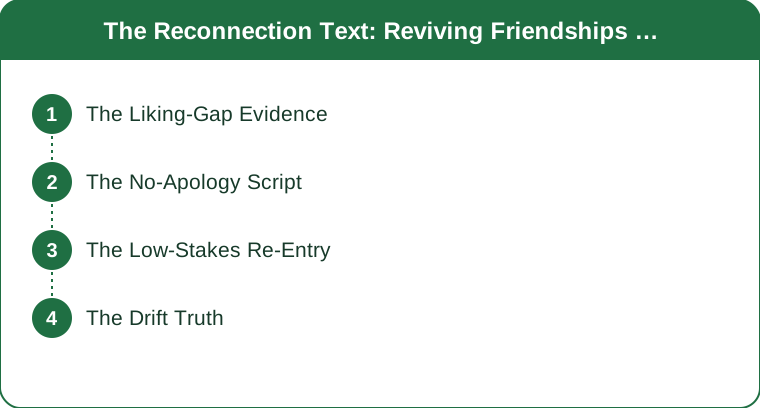
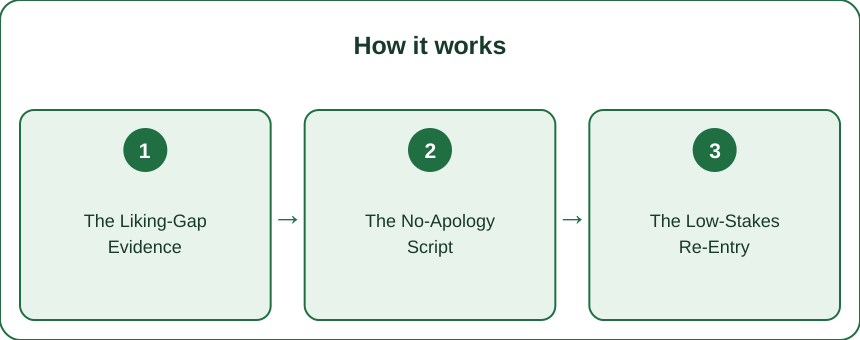
Studies on the “liking gap” and on reaching out consistently find that people underestimate how much others appreciate being contacted. Work published in psychology journals has repeatedly shown that senders predict a lukewarm reception and recipients report being genuinely, measurably pleased — and the gap is largest for surprise contact after a long silence, which is exactly the message you’re not sending.
Your awkwardness math is wrong in your favor. Every time.
The mechanism is simple: you’re comparing your imagined intrusion against their imagined indifference, and you have no data on the second half. They, meanwhile, are experiencing “someone thought of me.”
What Should the Reconnection Text Actually Say?
Skip the sorry-it’s-been-so-long overture. It makes the gap the topic, which forces them to either absolve you or negotiate blame — and now the conversation is about the silence instead of about them.
The script that works: specific memory plus genuine question.
“Just walked past that terrible Thai place we used to go to and thought of you immediately. How ARE you?”
“Someone at work said ‘unprecedented’ four times in one meeting and I genuinely needed you there. How’s everything?”
“Your old playlist came up on shuffle. Made me realize it’s been ages — what’s new with you?”
The specific memory does two jobs: it proves you actually thought about them, not just about your list of lapsed contacts, and it gives them something easy to reply to.
The gap closes by being ignored.

How Do You Keep the Stakes Low?
First contact is a text, not a summit.
A meme forward, a photo of a place you both loved, a two-line check-in. Do not open with a coffee invitation — that asks them to make a calendar decision before they’ve re-established the emotional footing, and it’s the most common reason a good reconnection stalls.
Then read the temperature. If warmth returns — a real reply, a question back, a story — escalate to coffee or a call. If the reply is short and polite, you lost nothing but a stamp, and you can leave the door open without walking through it.
A useful timeline: text, wait, respond warmly, and let a proper invitation happen on the second or third exchange. Friendships that rekindle usually do so over a few days, not in one message.
The Truth About Why Friendships Drift
Most drifted friendships ended by logistics, not verdicts.
Parenthood seasons. A move across a time zone. A job that ate two years. A period where one of you was struggling and communicating badly. None of these are judgments about the friendship — they’re just what happens when nobody’s schedule accommodates the other’s.
The affection usually survived in storage. One text is the inventory check, and the hit rate on old, real friendships is remarkably high.
The friendships that don’t revive typically fell apart for an actual reason — and knowing that is its own kind of useful information, delivered at the cost of one message.
5 Mistakes Everyone Makes Reaching Out
1. Leading with an apology. Covered above, and it’s the most common one by far. It centers the silence and puts them in the awkward position.
2. Making the first message a big ask. “We should catch up properly — are you free Thursday?” is a lot to receive from someone you haven’t heard from in two years. Text first, plan later.
3. Waiting for the perfect moment. There isn’t one. A Tuesday afternoon is as good as anything, and “I don’t want to interrupt” is anxiety wearing a considerate hat.
4. Reading a slow reply as rejection. People are busy and phones are chaotic. A reply three days later is normal, not a verdict. Give it a week or two before drawing any conclusion.
5. Only reaching out when you need something. If the reconnection is genuinely warm, let it exist for a while before it becomes useful. Otherwise the text reads as a transaction, and people can tell.
Mini FAQ
What if they don’t reply at all?
Then you’ve learned something with very little cost, and you’re allowed one more low-key attempt months later if you want. Beyond that, let it be. A non-reply is far more often about their life than about you — but it’s also a boundary worth respecting.
Is it too late after five years? Ten?
No. The liking-gap effect doesn’t have an expiry date, and long-gap reconnections are frequently the warmest ones precisely because the surprise is bigger. “I know it’s been forever” is fine to acknowledge in one clause — just don’t build the message around it.
What if the friendship ended over an actual conflict?
That’s a different message and it does need directness — a brief, non-defensive acknowledgment of what happened, and no expectation of a particular response. It’s also entirely reasonable to decide that one stays closed.
TL;DR:
- People consistently underestimate how welcome a reconnection message is — the research is clear on this.
- Skip the apology; lead with a specific shared memory plus a genuine question.
- Text first, keep it small, and let the coffee invitation come on the second or third exchange.
- Most drift is logistics, not verdicts — the affection usually survived.
- A slow or thin reply costs you nothing; wait a week or two before concluding anything.
Skip the apology, lead with the memory, keep stakes low, trust the liking gap. The friend you keep meaning to text is probably keeping meaning to text you — someone gets to go first, and it pays to be her.
Keep Reading
This article is for general informational and styling purposes only. Fit, sizing, and product availability may vary.