The Group Chat Etiquette Nobody Explains (But Everyone Judges You On)
Quick Answer: The core unwritten rules that keep a friend group chat healthy are responding without pressure to reply instantly every time, not letting the chat become the only form of contact with people you’re actually close to, and being mindful that a running joke or inside reference that dominates the chat can unintentionally make quieter or newer members feel excluded.
Group chats work best when treated as one layer of a friendship, not the entire relationship — a distinction that’s easy to lose track of once a chat becomes a daily habit.

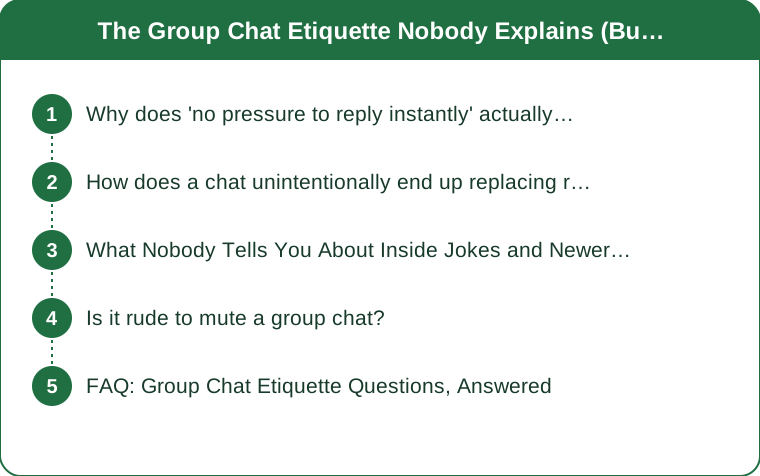
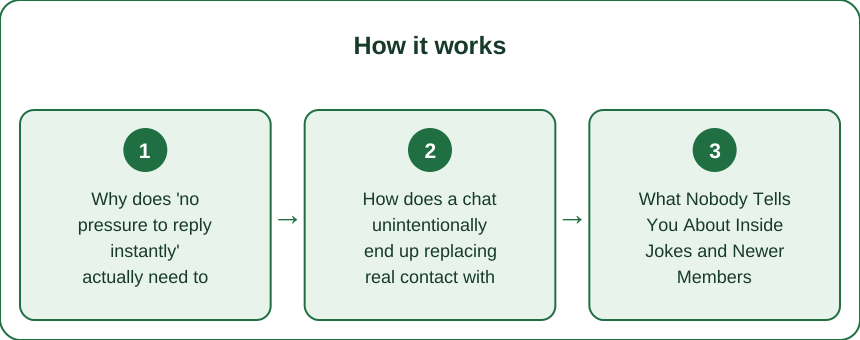
Why does ‘no pressure to reply instantly’ actually need to be an explicit rule?
Group chats create an ambient expectation of near-constant availability that individual friendships rarely demand, and without an explicit understanding that delayed responses are fine, some members start to feel low-grade guilt or FOMO around a chat that was originally meant to reduce friendship maintenance effort, not add to it.
How does a chat unintentionally end up replacing real contact with someone?
It’s easy for group chat interaction (reacting to messages, occasional one-line comments) to start feeling like it satisfies the need to actually check in with someone, when it’s a much lower-effort, lower-connection form of contact than a real conversation — noticing when a chat has fully replaced one-on-one contact with a specific friend is worth occasionally checking.

What Nobody Tells You About Inside Jokes and Newer Members
A long-running group chat inevitably accumulates references and inside jokes that feel warm to established members but can make anyone newer to the group feel like they’re watching a conversation from outside — occasionally explaining a reference or looping a newer member in, rather than assuming context, keeps the chat from quietly gatekeeping.
Is it rude to mute a group chat?
No — muting a chat to manage notification overload while still checking in periodically is a reasonable way to stay part of a group without the chat dictating your attention constantly, and most people don’t actually notice or mind when someone’s response pattern reflects a muted chat rather than active avoidance.
FAQ: Group Chat Etiquette Questions, Answered
How do you handle a group chat member who dominates the conversation?
A private, kind conversation acknowledging you enjoy their energy while gently noting the chat sometimes feels one-directional tends to land better than addressing it in the group itself, which can feel like a public callout.
Is it okay to leave a group chat that no longer feels valuable?
Yes — leaving a chat that’s become more obligation than connection is a reasonable boundary, and framing it honestly (‘I need to step back from group chats generally right now’) tends to be received better than quietly going silent for months.
Should every message get some kind of response or acknowledgment?
No — a reaction emoji or simply reading a message without a full reply is a completely normal and accepted form of light engagement in most group chats, and treating every message as requiring a written response is a fast route to chat fatigue.
TL;DR:
- Group chats work best without an implicit expectation of instant replies
- Watch for a chat quietly replacing real one-on-one contact with specific friends
- Loop newer members into inside jokes rather than assuming shared context
- Muting, reacting instead of replying, and even leaving are all reasonable, normal choices
Treating a group chat as one layer of friendship, not the whole relationship, keeps it a genuine connective tool instead of a quiet source of social pressure.
Keep Reading
This article is for general informational and styling purposes only. Fit, sizing, and product availability may vary.