What to Actually Do When You're Always the One Reaching Out First in a Friendship
Quick Answer: Before assuming a friendship is one-sided, it’s worth distinguishing between a friend who’s genuinely less inclined to initiate but still responsive and engaged when you do reach out, versus a friend who’s also unresponsive or low-effort once contact happens — the first pattern often reflects personality differences in initiation style, not lower investment, while the second is a clearer signal worth addressing directly.
Feeling like the only one reaching out is a common, often painful friendship pattern. It’s worth a closer look before concluding what it actually means.

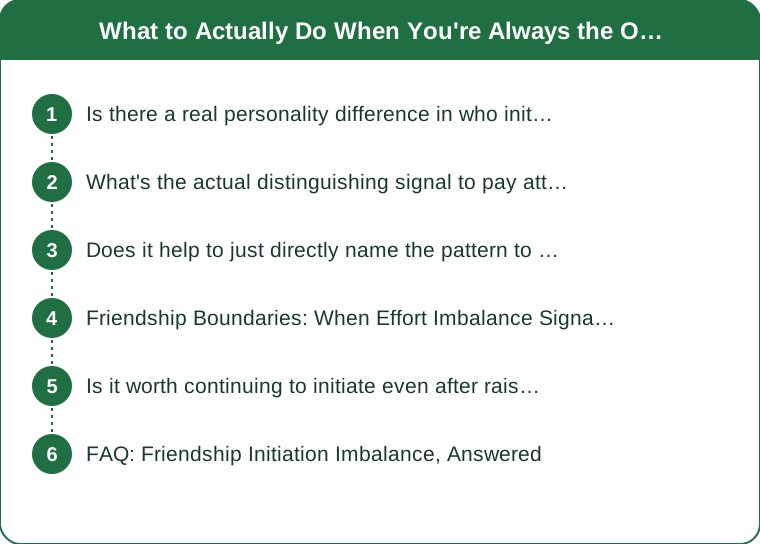
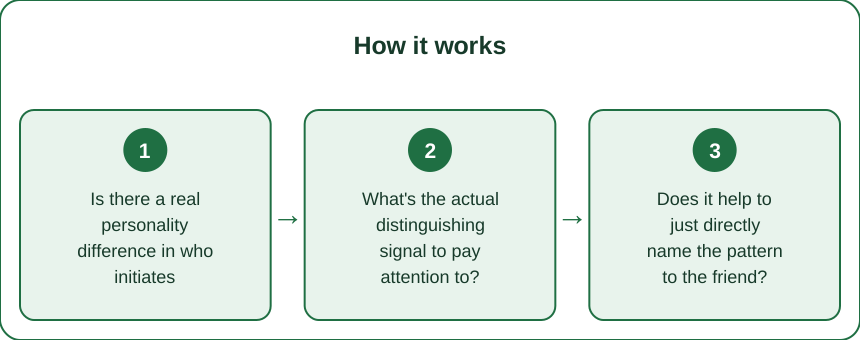
Is there a real personality difference in who initiates contact?
Yes — research on friendship maintenance consistently shows that some people are simply lower initiators by disposition (often correlating with introversion or just habit) while still being genuinely invested in and responsive to the friendship once contact happens. Initiation frequency alone isn’t a reliable single measure of how much someone values a friendship.
What’s the actual distinguishing signal to pay attention to?
The more telling pattern is responsiveness and engagement once you do initiate — a friend who responds warmly, makes time, and engages fully when you reach out is showing investment differently than through initiation. A friend who’s also slow, distracted, or low-effort in their responses is a clearer signal of an actual imbalance worth addressing.
Does it help to just directly name the pattern to the friend?
Often, yes — naming the pattern honestly and without accusation (‘I’ve noticed I’m usually the one reaching out, and I’d love to hear from you sometimes too’) gives the friend a chance to either explain their side or adjust, rather than continuing an assumption-based dynamic that can quietly erode the friendship over time.

Friendship Boundaries: When Effort Imbalance Signals a Bigger Issue
If a direct conversation about the imbalance is met with defensiveness, dismissal, or no real change over time, that response itself becomes useful information about the friendship’s actual health, separate from the original initiation pattern. A friendship that can’t tolerate a gentle, honest conversation about effort has a deeper issue than who texts first.
Is it worth continuing to initiate even after raising the concern once?
It depends on the response — if the friend engages positively and shows some effort change, continuing to initiate some of the time is reasonable, since few friendships achieve perfectly equal initiation. If nothing changes after a genuine conversation, scaling back your own initiation to see what happens is a fair way to get clearer information about the friendship’s actual state.
FAQ: Friendship Initiation Imbalance, Answered
Is it petty to keep track of who reaches out first?
Noticing a pattern isn’t petty — it becomes a concern worth addressing when the pattern is consistent and starts affecting how you feel about the friendship.
Should you stop initiating entirely to ‘test’ the friendship?
A full stop can feel manipulative or provide unclear information (a quiet period isn’t uncommon even in healthy friendships); a gradual scale-back paired with honest conversation is generally more constructive.
Can a friendship survive with one person always initiating?
Yes, many healthy long-term friendships have one consistent initiator, as long as the other person remains genuinely responsive and engaged when contact happens.
TL;DR:
- Low initiation doesn’t automatically mean low investment — responsiveness matters more
- The clearer red flag is low engagement once you do reach out, not initiation alone
- Naming the pattern honestly often gets more useful information than assuming
- A friendship that can’t handle that conversation reveals more than the initiation pattern itself
Before writing off a friendship as one-sided, check whether it’s really about initiation or about how your friend shows up once you do reach out — those are different problems with different answers.
Keep Reading
This article is for general informational and styling purposes only. Fit, sizing, and product availability may vary.