When Your Friends Are on Different Timelines: Staying Close Across Life Stages
Quick Answer: Friendships that survive diverging life stages do three things on purpose. They switch from circumstance-based to choice-based, meaning someone actively initiates instead of relying on proximity. They renegotiate the format while keeping the frequency — a stroller walk or a 20-minute call instead of the old dinners. And they stay genuinely curious about a life that no longer looks like their own.
At some point the group chat diverges.
One friend is in the newborn trenches and communicating exclusively in voice memos recorded at 2am. One is planning a sabbatical. One is caregiving for a parent and hasn’t slept properly in months. One is dating with a spreadsheet.
Different timelines strain friendships that quietly assumed synchrony. Most people experience this as drifting, which sounds passive and inevitable.
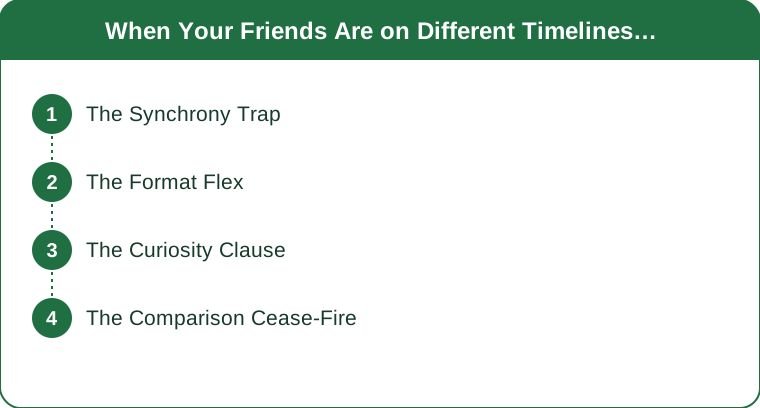
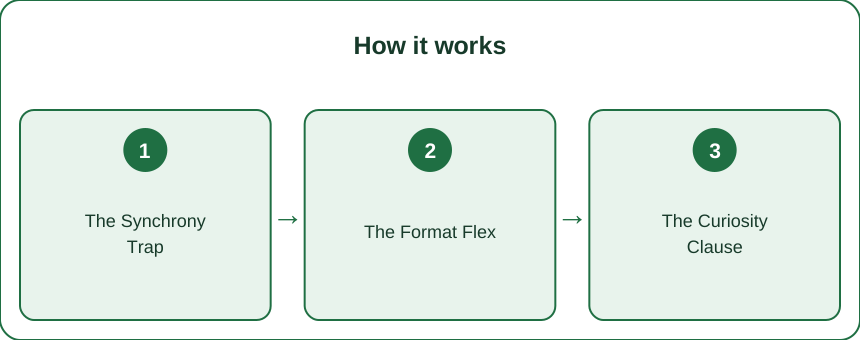
It isn’t. The friendships that survive divergence do three specific things, and all three are deliberate.

Why Do Friendships Drift When Life Stages Change?
Because most friendships were built on circumstance, and nobody noticed.
You met at the same office, in the same neighborhood, at the same stage of life. The friendship required almost no initiation because proximity handled it — you saw each other by default, and the relationship grew in the space that made.
When the circumstance disappears, the default disappears with it. Nothing went wrong. The mechanism that was doing all the work just stopped.
The friendship now has to switch from circumstance-based to choice-based, which means somebody has to actually initiate, repeatedly, without the situation prompting it.
That switch is deliberate or it doesn’t happen. There’s no version where it occurs on its own, and this is why so many good friendships end without an argument — nobody chose to end it, and nobody chose to continue it either.
The Format Flex
Here’s the practical move that saves more friendships than any other: renegotiate the format, keep the frequency.
The common failure is trying to preserve the old format and then concluding the friendship is over when it doesn’t work. Dinners at 8pm don’t work for someone with a newborn. That’s not a statement about the friendship. It’s a statement about 8pm.
What flexing looks like:
The new parent can’t do dinner but can do a stroller walk at 10am, a coffee at their kitchen table, or voice memos exchanged across a week. Voice memos in particular are underrated — asynchronous, low-pressure, and they carry tone in a way texting doesn’t.
The caregiver can do a 20-minute call while driving, or an hour when someone else is covering. Short and reliable beats long and impossible.
The friend with the demanding job can do a standing early breakfast better than an unpredictable evening.
The friend in a different time zone can do a scheduled monthly video call. Scheduled sounds unromantic and is far more effective than “we should catch up soon.”
The principle: meet people inside their actual lives instead of mourning the format you used to have. A friendship that adapts its container survives; one that insists on the original container usually doesn’t.

The Curiosity Clause
Divergence kills friendships through assumed boredom more than through actual distance.
The thought is always some version of: “She doesn’t want to hear about diapers.” Or: “He can’t relate to what I’m dealing with with my mother.” Or: “My sabbatical planning must sound self-indulgent to someone who’s exhausted.”
So people pre-edit. They stop sharing the actual substance of their lives and the conversation shrinks to logistics and pleasantries — at which point it genuinely does get boring, and the assumption becomes true after the fact.
The fix is aggressive curiosity in both directions. Ask real questions about the newborn trench and about the sabbatical spreadsheet. Not polite questions — specific ones. “What’s the hardest part of the night?” is a different question than “How’s the baby?”
Different lives are content, not distance. Your friend in a completely different chapter is one of the more interesting people you have access to, precisely because their days look nothing like yours.
And share your own thing without apology. Pre-editing yourself out of the friendship is the same mistake from the other side.
The Comparison Cease-Fire
Diverging timelines invite scorekeeping, and it’s usually silent.
Who’s ahead. Whose choices got validated. Whether your friend’s life is an implicit commentary on yours. This runs quietly underneath a lot of strained friendships and rarely gets said out loud, which is exactly what makes it corrosive.
The friendships that last declare the race fictional.
Her chapter is not your critique. Your chapter is not her critique. Two people can make completely different decisions about children, careers, cities, and partners without either decision being an argument against the other.
In practice this means: noticing the comparison thought when it arrives and declining to act on it. Not congratulating yourself for being ahead, not defending yourself for being behind. Neither of those is a real position.
Cheering from a different chapter is the entire advanced skill. Being genuinely glad about a friend’s promotion when your own work is stalled, or about their pregnancy when yours isn’t happening, is difficult and it’s the whole thing. It’s also allowed to be complicated — you can feel the sting and still show up warmly, and that combination is honest rather than hypocritical.
What Nobody Tells You
Somebody has to initiate more, and it usually isn’t equal. In any given season, one friend has more capacity than the other. Keeping score of who texts first is a reliable way to lose friendships that were only ever temporarily lopsided.
The friend in crisis often can’t reciprocate for a while. Caregiving, a new baby, illness, a hard divorce — these consume the capacity to maintain relationships. Being the one who keeps showing up during that stretch is the friendship, and it usually comes back around.
Low-effort contact is real contact. Sending a link, a photo, a “thought of you.” It’s not a lesser form of friendship; it’s the connective tissue between the longer conversations.
Some friendships are seasonal and that’s not a failure. Not every friendship is meant to cross every life stage. Letting one become an occasional warm exchange rather than forcing it back to what it was is a legitimate outcome, not a loss.
Mini FAQ
How do you stay friends when your lives are completely different?
Switch from relying on shared circumstance to actively choosing the friendship, change the format to fit both people’s real constraints, and stay genuinely curious about the parts of their life you don’t share. Frequency matters more than duration — short and reliable beats long and rare.
Is it normal to drift from friends after having a baby?
Very. The format that sustained the friendship usually becomes impossible for a while, and both people often read that as rejection. Naming it directly — “I can’t do dinners right now, but I can do a walk on Saturday morning” — prevents most of the damage.
How do you handle jealousy of a friend in a different life stage?
Notice it without acting on it, and separate the feeling from the friendship. You can be genuinely happy for someone and still feel a sting about your own timeline — those aren’t in conflict. What damages friendships is letting the comparison shape how you show up, not experiencing it.
TL;DR:
- Most friendships run on circumstance. When it disappears, someone has to choose the friendship deliberately.
- Flex the format, keep the frequency: stroller walks, voice memos, 20-minute calls, scheduled monthly video.
- Assumed boredom kills more friendships than distance. Ask specific questions; share your own thing unedited.
- Retire the scoreboard. Her chapter isn’t your critique.
- Effort is rarely equal in any given season, and that’s fine. Low-effort contact still counts.
Choose the friendship over the circumstance, flex the format, stay aggressively curious, retire the scoreboard. Different timelines were never the threat — assuming friendship required matching ones was.
Keep Reading
This article is for general informational and styling purposes only. Fit, sizing, and product availability may vary.