How to Actually Say No to a Friend's Invitation Without the Guilt Spiral
Quick Answer: Declining without guilt spiraling usually comes down to giving a brief, honest reason without over-explaining or apologizing excessively, trusting that a good friendship can absorb an occasional no, and separating the discomfort of saying no from any actual evidence that the friendship has been damaged — most guilt after declining is anticipatory and disproportionate to any real relational cost.
The guilt itself, more than the actual decline, is usually what makes this feel harder than it needs to be.

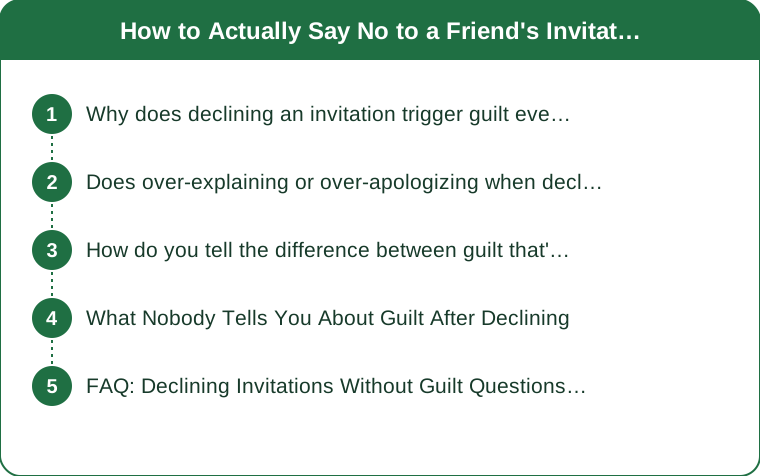
Why does declining an invitation trigger guilt even when the reason is completely valid?
Guilt after declining often isn’t proportional to actual harm done — it’s frequently an anticipatory reaction based on assumed disappointment, rather than confirmed disappointment. Many people imagine a much stronger negative reaction from the friend than what typically actually occurs.
Does over-explaining or over-apologizing when declining actually help?
Generally it makes the guilt worse, not better — extensive justification can signal that the decline itself is a bigger deal than it needs to be, and can also come across as less genuine than a brief, honest response. A short, warm decline without a lengthy justification is usually both more comfortable and better received.

How do you tell the difference between guilt that’s disproportionate and a friendship pattern that’s genuinely a problem?
A single decline followed by lingering unease is usually just anticipatory guilt working itself out, while a pattern of consistently one-sided invitations, or a friend who reacts with disproportionate anger or withdrawal to occasional declines, is a separate and legitimate concern worth addressing directly rather than something to guilt yourself out of noticing.
What Nobody Tells You About Guilt After Declining
Here’s what’s often missing from this advice: the guilt frequently fades faster than expected once the initial decline is sent, and checking back in later (even mentally) often reveals the anticipated fallout didn’t materialize the way it felt like it would in the moment before declining. This gap between anticipated and actual reaction is worth noticing as a pattern over time.
FAQ: Declining Invitations Without Guilt Questions, Answered
Is it necessary to always offer an alternative plan when declining?
Not necessarily — offering an alternative is a kind gesture when genuinely wanted, but it isn’t required for a decline to be considerate, and forcing an alternative when there isn’t real capacity for one can create more obligation than intended.
Does the method of declining (text vs. call vs. in person) matter for how it’s received?
For most casual invitations, a text is completely appropriate; a call or in-person conversation is worth considering for closer friends or more significant plans, mainly out of respect for the relationship’s importance rather than any strict rule.
What if guilt persists long after declining, even when nothing bad seems to have happened?
Persistent guilt disproportionate to any actual relational fallout is worth examining on its own, separate from the specific invitation — it may reflect a broader pattern worth noticing in how boundaries feel generally, rather than something specific to that one friendship.
TL;DR:
- Guilt after declining is usually anticipatory, not proportional to actual friend reaction
- Over-explaining or over-apologizing tends to make the guilt feel worse, not better
- A pattern of one-sided invitations is a separate, legitimate concern from normal declining guilt
- Guilt often fades faster than expected once the decline is actually sent
A brief, honest decline usually holds up fine in a real friendship — the guilt is rarely evidence that anything was actually damaged.
Keep Reading
This article is for general informational and styling purposes only. Fit, sizing, and product availability may vary.