Why You Can Have a Full Social Calendar and Still Feel Lonely
Quick Answer: Loneliness is more strongly tied to the depth and quality of connection than to how many social events are on the calendar — a large number of surface-level interactions can leave the specific need for deep, mutual understanding unmet even while feeling socially busy. Researchers describe this as the difference between social contact and social connection, and it’s a distinct, well-documented experience.
A calendar full of coffee dates, group chats, and after-work plans looks like the opposite of loneliness from the outside — but plenty of people report feeling quietly disconnected despite exactly that kind of full schedule, and it’s a specific enough pattern that it has research behind it.

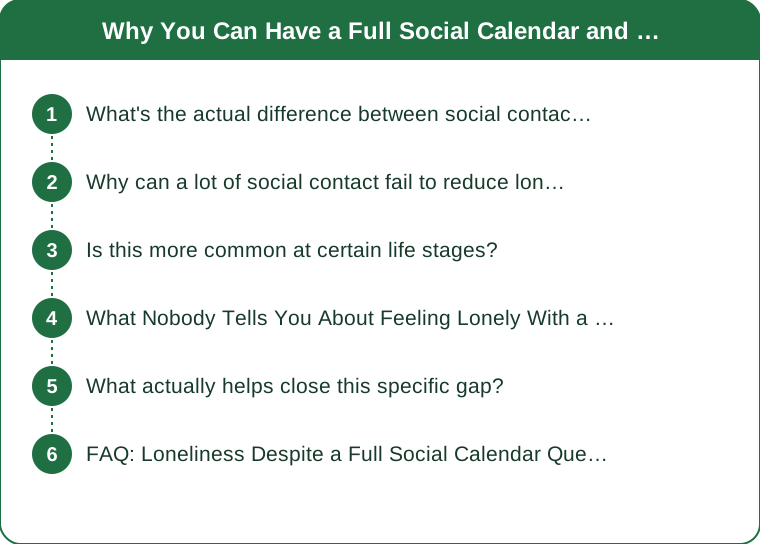
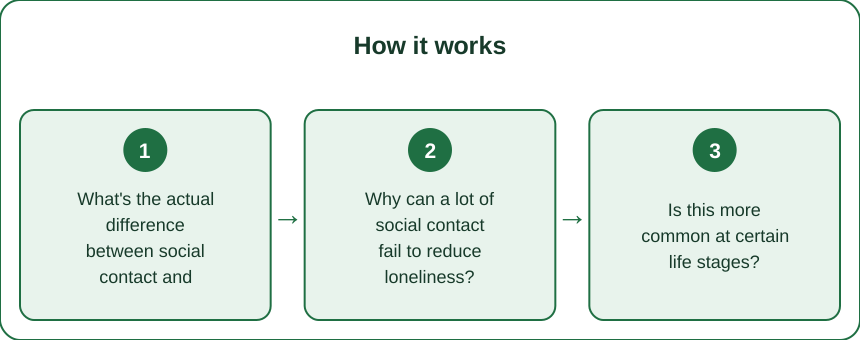
What’s the actual difference between social contact and social connection?
Social contact refers to the frequency of interactions — how often you’re around other people, while social connection refers to the depth of mutual understanding, vulnerability, and felt closeness in those interactions. A full calendar measures contact; loneliness is more about a gap in connection.
Why can a lot of social contact fail to reduce loneliness?
Many social interactions — group hangouts, work events, casual acquaintance catch-ups — don’t involve the kind of vulnerable, one-on-one depth that research associates with reduced loneliness, so quantity of contact and quality of connection can move in genuinely opposite directions.
Is this more common at certain life stages?
It’s frequently reported during busy career-building years or after a major life change (a move, a breakup, becoming a parent), when the social calendar often stays full through work and logistics-driven interactions, but the deeper friendships that provide real connection get less deliberate time and attention.

What Nobody Tells You About Feeling Lonely With a Full Social Calendar
Group settings can actually mask loneliness rather than resolve it, since being surrounded by people without a specific deep conversation still leaves the underlying need for closeness unaddressed — some people report feeling more aware of the gap in a crowded room than when genuinely alone.
This pattern is sometimes called “social loneliness” in research, distinct from “emotional loneliness” (missing one specific close attachment) — someone can have plenty of casual friends (low social loneliness) while still missing the one or two deep confidants that address emotional loneliness.
Digital communication volume doesn’t reliably substitute for depth either — a group chat with dozens of daily messages can still leave the underlying need for one substantive, undistracted conversation unmet.
What actually helps close this specific gap?
Prioritizing fewer, deeper one-on-one interactions over adding more group social events tends to be the more effective fix — this often means deliberately carving out time for a smaller number of relationships rather than trying to feel less lonely by adding more items to an already full calendar.
FAQ: Loneliness Despite a Full Social Calendar Questions, Answered
How do I tell if what I’m feeling is this specific kind of loneliness or something else, like depression?
This pattern is specifically tied to a gap between social quantity and connection quality; if low mood, appetite, or sleep changes are also present, it’s worth discussing with a professional rather than assuming it’s purely a friendship-depth issue.
Is it realistic to build deeper connection within an already busy schedule?
Yes — this is more about redirecting some existing social time toward fewer, more substantive interactions than adding significant new time to the calendar.
Does this affect introverts and extroverts differently?
Both report this pattern, though extroverts sometimes have more total social contact masking the connection gap for longer before it’s noticed. This is general information, not medical advice — persistent loneliness is worth discussing with a professional.
TL;DR:
- Loneliness tracks connection depth more than how many social events are on the calendar
- Social contact (frequency) and social connection (depth) are genuinely different things that can move apart
- This gap is sometimes called “social loneliness” versus “emotional loneliness” in research
- Redirecting existing social time toward fewer, deeper interactions tends to help more than adding more events
A full calendar was never proof against loneliness — it’s the depth within those plans that actually closes the gap.
Keep Reading
This article is for general informational and styling purposes only. Fit, sizing, and product availability may vary.